
 OpenMV MicroPython
 Detector de rostros Viola Jones#
El proyecto de muestra Viola-Jones que viene con la CMUcam3 es un ejemplo de un detector de rostros ligero. El algoritmo se basa en el conocido artículo «Robust Real-Time Face Detection» de P. Viola y M. Jones de 2004 (viola-ijcv04.pdf). La implementación en la CMUcam3 devolverá coordenadas de cuadros donde detecta un rostro en la imagen. Si prueba este código con un fondo relativamente uniforme (como una pared blanca), funciona razonablemente bien. Las imágenes se entrenan a partir de la base de datos de rostros de CMU de modo que se generalizan a todos los rostros. A veces, ciertos rostros con características que no se encuentran en la base de datos pueden confundir al detector.
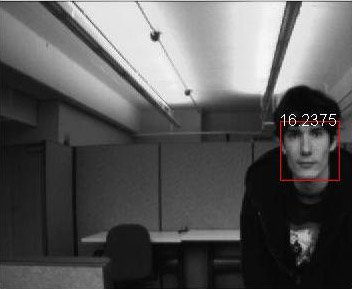
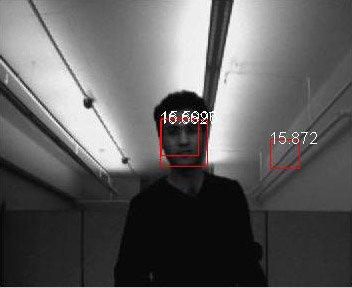
The paper (viola-ijcv04.pdf) introduces a novel technique to detect faces in real-time and with very high detection rate. It is essentially a feature-based approach in which a classifier is trained for Haar-like rectangular features selected by Adaboost. The test image is scanned at different scales and positions using a rectangular window, and the regions which pass the classifier are declared as faces. One of the major contributions of this paper is the extremely rapid computation of these features using the concept of Integral Image, which enables the detection in real-time. Additionally, instead of learning a single classifier and computing all the features for all the scanning windows in the image, a number of classifiers are learnt which are put together in a series to form a cascade. The classifiers in the beginning of the cascade are simpler and consist of smaller numbers of features. However, as one proceeds in the cascade, the classifiers become more complex. A region is reported as detection only if it passes all the classifier stages in the cascade. If it is rejected at any stage, it is discarded and not processed further. This way, the easier patches in the image which the «cascade of classifiers» is sure of not being a face, are rejected very early while the difficult regions are operated on by more complex classifiers. This greatly speeds up the detection process without compromising on the accuracy and provides high detection rate. This overall system provides performance comparable to the existing best face detector systems (Rowley et al., 1998 CVPR00.pdf; Schneiderman and Kanade, 2000 nips00.pdf; Roth at al., 2000 rowley-ieee.pdf) but with orders of magnitudes faster than any of these systems. On a conventional desktop, it can detect faces at 15 frames per second.
Puede encontrar más información sobre el detector de rostros Viola-Jones y su implementación en la CMUcam3 en nuestro documento CC3 Face Detector.
Utilidades e imágenes adicionales
generate_feat_in_struct_for_C.mEste archivo de Matlab imprime el modelo adaboost aprendido en un archivo de texto para que pueda importarse fácilmente en vj.h
-
Este archivo lo usa generate_feat_in_struct_for_C.m
Imágenes de prueba que usamos para el detector de rostros viola-jones