
 OpenMV MicroPython
 The CMUcam project#
Open Source Programmable Embedded Color Vision Sensors
Before the OpenMV Cam, there was the CMUcam. Beginning in 2000 at Carnegie Mellon University, the CMUcam line put real-time machine vision into a small, low-cost, low-power sensor – something a hobby robot or an 8-bit microcontroller could talk to over a plain serial port. Five generations followed over the next fourteen years, from the original CMUcam1 through to CMUcam5 (Pixy).
The OpenMV Cam grew directly out of that lineage: the same idea of an open-source, self-contained vision sensor for embedded systems, carried forward onto modern microcontrollers and MicroPython. The connection is direct – the hands-on experience behind the later CMUcams went straight into building the OpenMV Cam.
The original site, cmucam.org, has since gone offline. These pages preserve its camera overviews, wikis, and downloads for historical purposes, so the work is not lost. The text is reproduced from the original site with only minor cleanup.
Overview#
The goal of the CMUcam project is to provide simple vision capabilities to small embedded systems in the form of an intelligent sensor. The CMUcam open source programmable embedded color vision sensors are low-cost, low-power sensors for mobile robots. You can use the CMUcam vision systems to do many different kinds of on-board, real-time vision processing tasks.
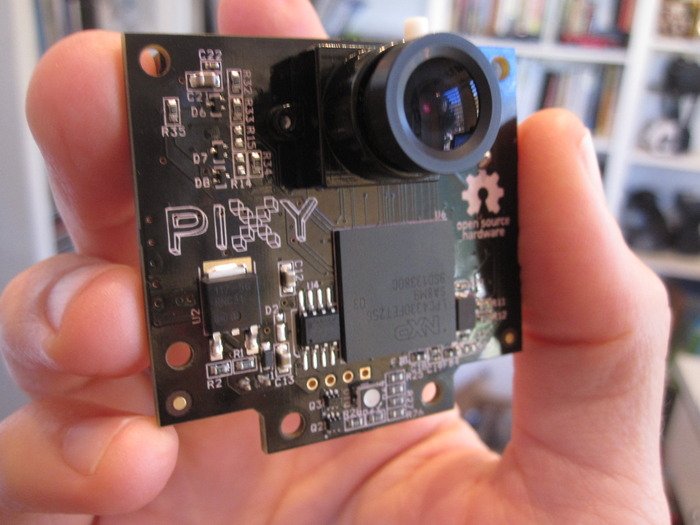
CMUcam5 (Pixy) 2014
Small, fast, and teachable — the Kickstarter hit that carried the CMUcam name to pixycam.com.
Explore →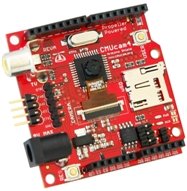
CMUcam4 2012
A Parallax Propeller-based, Arduino-shield-compatible tracking camera with a microSD card slot.
Explore →
CMUcam3 2007
An ARM7 fully programmable vision sensor — write custom C with the open-source CC3 library.
Explore →
CMUcam2 2003
Faster colour- and motion-tracking with servo control, image windowing, and analog video output.
Explore →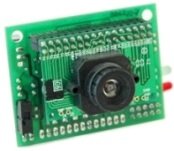
CMUcam1 2002
A low-cost, low-power serial vision sensor for mobile robots — tracks a colour blob at 17 frames per second.
Explore →Acknowledgments#
This project was supported through the generosity of the NASA Ames Intelligent Systems Program, Parallax, Lextronic, SparkFun, and the Semiconductor Research Corporation. This project is from The Electrical and Computer Engineering Department, The Robotics Institute (part of the School of Computer Science), and the Undergraduate Research Office at Carnegie Mellon University.