
 OpenMV MicroPython
 5.10. Bitwise operations#
The arithmetic operations on the previous page work on pixel values – the integer brightnesses or the packed colour words. Bitwise operations work one level lower, on the individual bits inside those values. For binary images, where each pixel is just one bit, the bitwise operations are the natural arithmetic.
5.10.1. The bitwise family#
The Image class exposes the full set of two-input bitwise operations:
b_and()– bitwise AND.b_or()– bitwise OR.b_xor()– bitwise exclusive-OR.b_nand()– NOT-AND.b_nor()– NOT-OR.b_xnor()– NOT-XOR.
Each operates per-bit on every byte of both images’ buffers. On a binary image, where each byte holds eight pixels, the operation runs on eight pixels per byte processed. On a grayscale or colour image it runs on every bit of every channel.
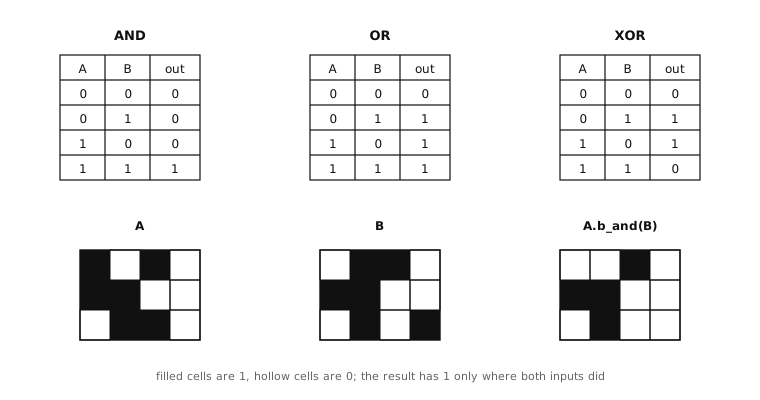
Top: the AND, OR, and XOR truth tables – the bit-level semantics of each operation. Bottom: two binary images A and B and the result of A.b_and(B), where the result keeps only the positions that were on in both inputs.#
5.10.2. Combining masks#
The single most common use of these operations is combining masks. A mask is a binary image that says, position by position, whether some condition is met. Two masks describing different conditions combine into a single mask describing a compound condition through one of the bitwise operations:
b_and() produces a mask whose positions are on only when both input masks were on at that position – the natural “and” of two conditions. Combining a foreground mask with the output of a thresholding pass through b_and restricts the threshold’s matches to the foreground.
b_or() produces a mask whose positions are on whenever either input mask was on – the natural “or”. ORing two thresholded outputs together produces a single mask covering anything that matched either of two colour ranges.
b_xor() produces a mask whose positions are on whenever exactly one input mask was on. Useful for detecting positions where two masks disagree – the positions where the threshold output changed between two frames, the symmetric difference between two reference masks, that kind of thing.
The negated variants – b_nand(), b_nor(), b_xnor() – produce the complement of their non-negated counterparts. They are useful when the natural way to describe a condition is “neither of these” or “not both” – not common, but worth knowing exist so that the negation does not have to be composed by following an AND with a separate invert().
5.10.3. Bitwise on non-binary images#
The bitwise operations also run on grayscale and colour images. They are most useful there when the image holds binary-like content – a grayscale frame whose pixels are all 0 or 255, an RGB565 frame with only fully-black and fully-white pixels – where AND, OR, and XOR give the same combinations they would on a true binary image. For images that span the full range of values, the arithmetic operations on the previous page are usually a better fit.