
 OpenMV MicroPython
14.6. Services and characteristics
Once GAP has gotten two devices into an open connection, the layer above it – the Generic Attribute Profile, GATT – has to give the bytes flowing through that connection meaning. BLE’s choice here is unusual. Where TCP exposes a raw byte stream and leaves it to the application to invent its own framing, GATT exposes a small key/value database that one side hosts and the other reads, writes, or subscribes to.
That database is what application designers spend most of their BLE time thinking about. What the camera publishes to a phone, what it watches on a remote sensor, how a Bluetooth keyboard tells its host which key was pressed – all are characteristic values in some GATT database somewhere.
14.6.1. Two role axes, not one
A frequent source of confusion: peripheral / central and server / client are two independent axes, not synonyms.
Peripheral and central are GAP roles, set during connection. The peripheral advertises and is connected to; the central scans and initiates the connection. This is settled the moment the link comes up and does not change.
Server and client are GATT roles, set per characteristic operation. The server hosts the characteristic; the client reads, writes, or subscribes to it.
The two axes are decoupled by the spec. A peripheral is usually the server (a heart-rate strap publishes its readings) and a central is usually the client (a phone reads them), but BLE allows any combination – a peripheral may discover a characteristic on the central it just got connected to, or a single connection can host services on both sides at once.
Most camera applications stick to the conventional pairing (peripheral + server, or central + client), so the rest of this section treats them as one axis when the conventional case is what’s being described. When the distinction matters, both terms are spelled out explicitly.
14.6.2. Inside the database
A GATT database is a tree. The leaves carry the actual bytes. The branches group related leaves into human-meaningful units.
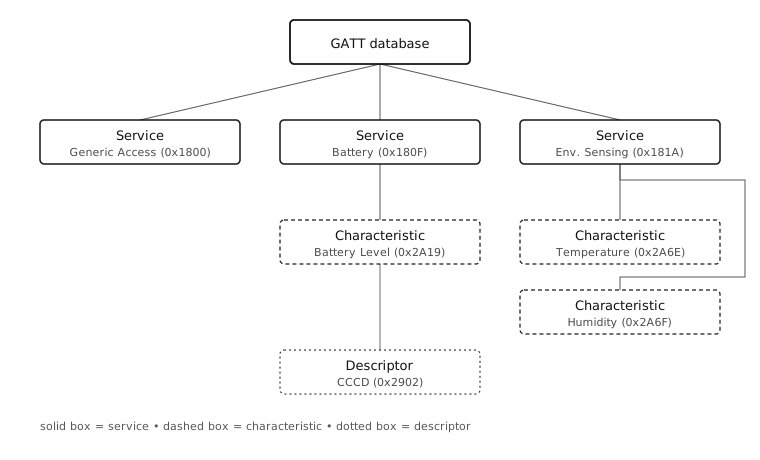
A GATT database. Services group characteristics; characteristics carry the application’s bytes; descriptors carry metadata about the characteristic.
There are three kinds of node:
A service is a logical group of related values. The Bluetooth SIG publishes standard service definitions for common use cases – Battery Service for battery level, Environmental Sensing for temperature / humidity / pressure, Heart Rate for heart-rate monitors – so a generic app on a phone can recognise a service it has never seen before. An application is also free to define its own services for things the SIG has not standardised.
A characteristic is one named value inside a service. Battery service has a single characteristic – Battery Level, a one-byte percentage. Environmental Sensing has separate characteristics for temperature, humidity, pressure, and so on. A characteristic is the unit of GATT operations – you read a characteristic, you write a characteristic, you subscribe to a characteristic.
A descriptor is metadata attached to a characteristic. Some descriptors are standardised – the Client Characteristic Configuration Descriptor (CCCD) is the famous one, because writing to it is how a client tells the server “send me notifications on this characteristic”. Others are user-defined and carry things like presentation format or extended properties.
A GATT server (typically the peripheral) declares its database once at startup and the database does not change while running. A GATT client (typically the central) discovers what is in the database after connecting – walking the tree, reading the UUIDs of the services it finds, then the characteristics inside each.
14.6.3. UUIDs
Every service, characteristic, and descriptor has a UUID (Universally Unique IDentifier) that identifies what kind of thing it is. UUIDs come in three widths:
16-bit. Reserved for standards defined by the Bluetooth SIG. Battery Service is
0x180F. Battery Level (a characteristic) is0x2A19. The full list is published on the Bluetooth SIG’s assigned-numbers site at https://www.bluetooth.com/specifications/assigned-numbers/.32-bit. A rarely-used middle ground.
128-bit. What everyone else uses – a vendor or application generates one at random and uses it for their custom service or characteristic. Cameras defining their own protocol live here.
The bluetooth.UUID class accepts any of the
three widths:
import bluetooth

BATTERY_SERVICE = bluetooth.UUID(0x180F)
CUSTOM_SERVICE = bluetooth.UUID("12345678-1234-5678-9abc-def012345678")
A 16-bit UUID encodes into a small advertising payload,
which is one reason standard services are preferable
when one exists – a heart-rate strap that advertises
0x180D (Heart Rate) costs two bytes; a custom UUID
costs sixteen. For applications that do not need
standard interoperability, a generated 128-bit UUID is
the right answer.
14.6.4. What the SIG-standardised services buy you
The case for using a standard service is straightforward:
existing apps already know how to talk to it. A device
that advertises the Heart Rate service (0x180D) and
exposes the Heart Rate Measurement characteristic
(0x2A37) works with every fitness app on the planet
without anyone writing new code. A device that
re-implements the same data with custom UUIDs needs its
own companion app and its own protocol document.
The standards do come at a cost. The byte layouts inside each characteristic are specified – the SIG decided that Heart Rate Measurement is a single-byte flags field followed by either an 8-bit or 16-bit heart rate value, optionally followed by R-R intervals – and a conformant device has to follow those layouts. Custom services are free of that constraint.
The pragmatic answer for cameras: use the standard service when one exists for the kind of data you have (Battery Service, Environmental Sensing), and define a custom one with a 128-bit UUID for anything specific to your application.
14.6.5. Server-side and client-side objects
For the same conceptual building blocks (service, characteristic, descriptor), every GATT library exposes two parallel sets of objects:
Server-side objects – what the peripheral declares it hosts. In
aioble:aioble.Service,aioble.Characteristic,aioble.Descriptor. These are constructed before advertising starts and registered withaioble.register_services().Client-side objects – what the central discovers on the peer after connecting. In
aioble:aioble.ClientService,aioble.ClientCharacteristic,aioble.ClientDescriptor. These are walked throughaioble.DeviceConnection.service()/services()after connecting.