
 OpenMV MicroPython
15.2. The four layers
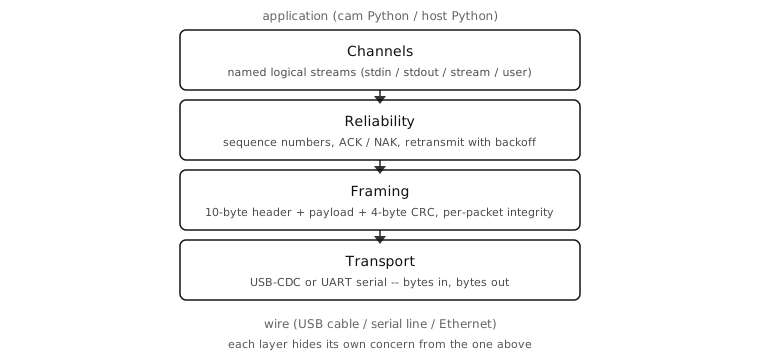
The protocol library is built as a stack of four layers, each one solving a single problem and building on the layer below it. The rest of the chapter walks the stack from bottom to top.
15.2.1. Transport
At the bottom is the byte pipe between the cam and the host. The protocol library doesn’t care which one carries the bytes:
USB-CDC over the USB port the cam is plugged into. The default and highest-bandwidth option for every cam.
UART over a pair of GPIO pins on the cam connected to a serial adapter on the host. Useful for headless deployments where the USB port is busy or isn’t physically accessible.
The transport’s only job is “bytes go in, bytes come out, in order”. Everything above this layer assumes that the transport delivers bytes in the order they were written, but allows for the bytes themselves to be corrupted or for the link to drop entirely. Lossy bursts (a few bytes missing) and clean drops (the whole link gone for a while, then back) are both handled higher up.
15.2.2. Framing
The next layer up imposes structure on the byte stream. Every message becomes a packet – a 10-byte header followed by a payload followed by a 4-byte trailer. The header carries:
A 2-byte sync word (
0xD5AA) that lets a receiver re-find the start of a packet after a desync.A 1-byte sequence number used by the reliability layer.
A 1-byte channel ID that says which logical stream the packet belongs to.
A 1-byte flags field for ACK / NAK / fragment / event bits.
A 1-byte opcode that distinguishes protocol commands, system commands, and channel commands.
A 2-byte payload length.
A 2-byte CRC over the previous eight header bytes.
The payload follows, then a 4-byte CRC over the payload itself. The two CRCs catch corruption independently: a flipped bit in the header invalidates the header CRC, and the receiver can drop the packet without ever needing to read the payload.
15.2.3. Reliability
The reliability layer turns “packets that might arrive” into “packets that have arrived.” It tracks the sequence numbers in the header, asks the other side to send acknowledgements for every packet that requires one, and retransmits when an acknowledgement doesn’t arrive within a timeout. By default the retransmit timeout starts at 500 ms and doubles on each retry, with three retries before giving up.
Each of those behaviours is configurable in the protocol.init()
call: ACK can be turned off for one-way streams, CRC validation
can be skipped on perfectly clean transports, and the retransmit
parameters can be tuned for slow or high-latency links.
15.2.4. Channels
The top layer is what application code sees. A channel is a named
logical stream identified by a channel ID from 0 to 31. Up to 32
channels can coexist on one transport; each one is independent of
the others, addressed by its ID in every packet’s header. The cam
boots with four built-in channels – stdin, stdout,
stream, and profile – and application code registers more
on top by calling protocol.register() with a Python class.
The four layers don’t mix concerns. Framing doesn’t know about channels; reliability doesn’t know about packet contents; the channel layer doesn’t know how the bytes arrive. That separation is why a transport swap (USB to UART, for example) doesn’t ripple up into the channel code, and it’s what makes the rest of the chapter walkable one layer at a time.