
 OpenMV MicroPython
7.9. TensorFlow Lite for Microcontrollers
TFLM is the runtime most cams use to execute a loaded model. It
parses the .tflite file – a FlatBuffer of operators, weights,
and tensor shapes – and walks the operator list in order,
dispatching each operator to a kernel that produces the next
intermediate tensor.
Intermediate tensors live in a fixed-size tensor arena allocated at load time. The cam sizes the arena in two passes: first, a throwaway interpreter is built against the maximum free heap so the model can report the working memory it needs; the persistent interpreter is then allocated with that exact size plus a small margin. Smaller models leave more heap free for the rest of the script.
TFLM is the engine on the H7, the RT1062, and the AE3.
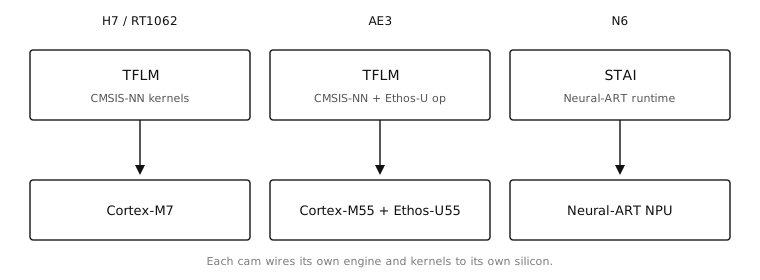
The engine in the middle of predict() is a
different stack on each cam family.
7.9.1. The op resolver
TFLM does not ship every kernel. The cam links in a resolver that lists the operators it can execute, and a model loaded against the resolver fails at load time if it contains an operator not on the list. The shipped build registers the operators common in vision and signal-processing networks – the convolution and dense layers, the pool and activation layers, the reshape and concat operators, the quantize and dequantize operators – so a model trained against one of the standard architectures (YOLO, MediaPipe, MobileNet) loads without extending the list.
The AE3 build additionally registers the Ethos-U operator. A
Vela-compiled model is otherwise a normal .tflite, and TFLM
walks it normally; the Vela-tagged subgraphs hit the Ethos-U
operator and dispatch to the NPU.