
 OpenMV MicroPython
7.1. What is a neural network
A neural network is an algorithm whose behaviour is learned from examples rather than coded by hand. The same network architecture, given a million face images, learns to detect faces. The same architecture, given a million hand images, learns to detect hands. The same architecture, given a labelled set covering many object categories, learns to detect all of them at once. Only the weights change between targets, and the weights are produced by an off-board training process that watches the network’s predictions against labelled examples and adjusts the weights until they match.
7.1.1. The mechanism
A neural network is a stack of layers. Each layer multiplies the previous layer’s output by a matrix of weights, adds a bias vector, and applies a non-linear function to the result. The output of one layer is the input to the next. A captured image enters at the top of the stack, flows down through tens or hundreds of layers, and emerges at the bottom as a tensor whose entries describe what was in the image.
What each layer’s weights do depends on what the network was trained on. An early-layer weight matrix in a vision network might fire on a short horizontal edge; a slightly deeper one might fire on a corner; a deeper one might fire on a circular eye shape; the deepest layers might fire on whole-face arrangements. None of this was written by hand. The training process iterated over millions of labelled examples, nudged the weights downhill on a loss function, and the edge-then-corner-then-eye-then-face hierarchy fell out of the data.
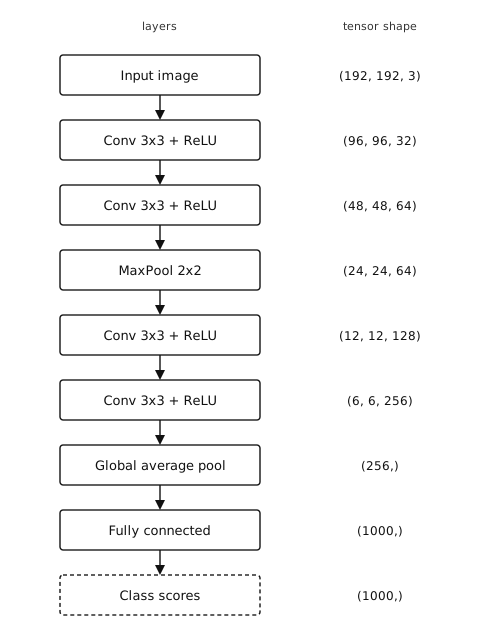
A small classification network as a stack of layers. The input tensor enters at the top with the captured image’s shape and flows down through the layers, with each one transforming the tensor’s dimensions. The output tensor at the bottom has one entry per class. Detection and keypoint networks share the same stack-of-layers form; only the output tensor’s interpretation changes.
The network’s architecture – how the layers are arranged, which operations connect them – is what the network can do. The weights are what the network has learned. The cam’s part of this is to load the weights file produced by training and run the same arithmetic the trainer ran, but on the captured frame instead of the training set.
7.1.2. What gets fed in, what comes out
Both ends of the network are tensors – multi-dimensional arrays of
numbers, the same kind of object the numpy chapter just introduced.
The input tensor for a vision network is the captured image
re-arranged into the layout the network expects: typically a
(B, H, W, C) 4-tuple shape where B is the batch dimension
(always 1 on the cam, since one frame is processed at a time), H
and W are the network’s expected pixel height and width, and
C is the channel count (3 for an RGB network, 1 for grayscale).
The output tensor depends on what the network is for:
A classification network produces a 1-D tensor of confidence scores, one per class. The index of the largest score is the predicted class. The MobileNet-derived person detector that ships on most cams is this form: two scores, one for “person”, one for “not person”.
A detection network produces a 2-D tensor whose entries describe a list of bounding boxes plus class probabilities. YOLOv8 is this form: an
(84, N)tensor where 4 of the 84 rows are box-regression values and the other 80 are per-class probabilities, repeated acrossNanchor positions.A keypoint network produces a tensor whose entries are pixel positions of named landmarks. The MediaPipe face-landmarks model is this form: 468 keypoints per detected face.
A segmentation network produces a 2-D tensor whose entries are per-pixel class labels – the same dimensions as the input, with a category index at every position.
A regression network produces a single number or a short vector of numbers – a depth estimate, an angle, a temperature.
Each form has its own post-processor on the cam that converts the raw output tensor back into the result form the rest of the application uses – bounding boxes, keypoint lists, class labels, numeric estimates. The post-processor is application-side code that knows the network’s output layout; the network itself is just the arithmetic that produces the tensor.
7.1.3. Why this works on a cam
Two pieces of arithmetic make this practical for a microcontroller-class part. The first is quantization. Training happens in 32-bit floating-point arithmetic; inference can run in 8-bit integer arithmetic with almost no accuracy loss for most networks. Eight-bit weights take a quarter of the storage and run several times faster than the 32-bit floats. Every model the cam ships with has already been quantized off-board.
The second is hardware acceleration. The same arithmetic that a microcontroller’s CPU plods through one instruction at a time, a neural-network accelerator runs hundreds of operations at once. The newer cams (the AE3 and the N6) carry a dedicated neural processing unit (NPU) – a tensor accelerator on the SoC – that turns a model which would have taken a second to run on the CPU into one that runs in tens of milliseconds. The Inference engines chapter covers what the cam’s part of this looks like.
7.1.4. What the chapter covers
Training is not the cam’s job. A trained model arrives on the cam as
a .tflite file; the cam loads it, runs each captured frame
through it, and decodes the resulting tensor into a result the
application can act on. Everything that follows is
about each of those steps:
loading and inspecting a model;
the flash partition where model files live;
the four stages of an inference call;
the engines that actually do the arithmetic;
and the post-processors that turn an output tensor back into a list of boxes, keypoints, or classes.
The detectors in the image chapter were each scoped to a particular target. The ones the rest of this chapter covers are trained from data instead, with the same engine running whatever model the script loads. The workflow change that came with them – a target-specific algorithm replaced by a target-specific weights file – is the next thing to draw out.