
 OpenMV MicroPython
12.10. TCP – a reliable stream of bytes
TCP, the Transmission Control Protocol, is the other transport-layer service on top of IP. Where UDP is best described as “send a packet and hope”, TCP is “open a connection between two endpoints and treat it as a two-way pipe of bytes that the other side definitely gets, in order, and exactly once”. Most internet traffic uses it, and most of what the camera does on the network uses it too.
12.10.1. What TCP adds to IP
TCP does much more than UDP. It adds:
A connection. Before any data flows, the two endpoints exchange a short handshake to agree they are talking. The connection has a state – “open”, “half-closed”, “closed” – that both sides track.
Reliable delivery. Every byte the sender puts in is acknowledged by the receiver. Anything not acknowledged within a timeout is sent again. The application never sees a lost byte; it sees a delay while the protocol resends.
In-order delivery. Bytes arrive in the same order they were sent. Even if packets arrive at the receiver out of order, TCP re-orders them before the application reads.
Flow control. If the receiver is slow, the sender is told to slow down; the connection adapts to the weaker end’s rate.
Congestion control. If the network in the middle starts dropping packets, the sender backs off until things recover. This keeps any one connection from taking down a saturated link.
All of this is automatic. The Python API the
application uses is simply send(bytes) and
recv(n); TCP handles everything else underneath.
12.10.2. The handshake
A TCP connection opens with a three-way exchange before any data is allowed through:
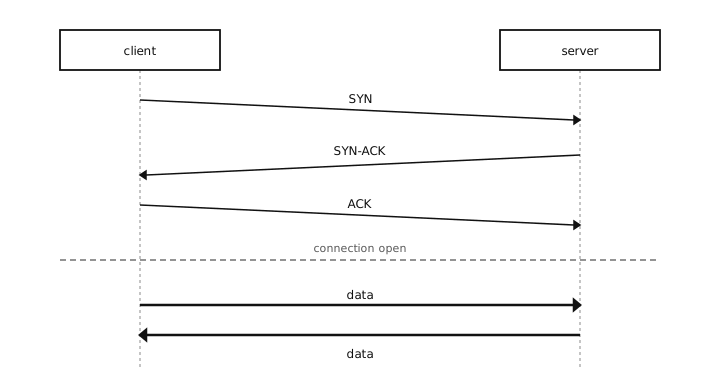
The three-way handshake. Once both sides have acknowledged, the connection is open and data can flow.
The client sends a SYN (synchronise) packet asking to open. The server replies with SYN-ACK (synchronise + acknowledge), accepting. The client sends a final ACK to confirm. After this round trip, both sides agree the connection is open and have synchronised their counters for tracking which bytes have been sent and received.
The handshake costs one round-trip-time of latency before the first useful byte gets through. For local networks that is a millisecond; for cross-continent connections that is roughly 100 ms. This is the main cost of TCP and the reason short, one-shot messages are sometimes better off using UDP instead.
12.10.2.1. The closing handshake
TCP connections also close with an exchange (a FIN
from each side). Either end can close its half of the
connection independently; a half-closed state where
one side has finished sending but the other is still
talking is legal, though uncommon. The application
normally just calls close() and lets the protocol
handle the shutdown sequence.
12.10.3. What TCP does not guarantee
A few things TCP is sometimes assumed to do but does not:
Message boundaries. The application sends a stream of bytes, not a stream of messages. Two
send(b"hello")calls might arrive as onerecv()ofb"hellohello", or as tworecv()s of varying sizes. If the application wants message framing, it has to add the framing itself (a newline, a length prefix, whatever). Sending JSON documents over TCP, for example, needs each document separated by a newline or some other marker.Encryption. TCP carries the bytes the application gave it, in the clear, all the way. If the contents need to be confidential, the application has to wrap the connection in TLS (see Encrypted sockets and TLS).
Authentication. TCP makes sure the bytes arrived intact. It says nothing about who sent them. Authentication is also a higher-layer concern.
Liveness on a quiet connection. If neither side sends data for a long time, the connection is technically still open but cannot detect that the other end has crashed or disappeared. Keepalive probes can be enabled on the socket to fix this when it matters.
12.10.4. When to use TCP
TCP is the right answer for almost any conversation that fits the shape “client opens a connection to a server, they exchange some bytes, the connection closes when done”. HTTP and HTTPS requests, SSH sessions, database queries, file transfers, image uploads – all over TCP.
Reach for UDP only when the conversation does not fit that shape: independent self-contained messages where loss is acceptable, multicast traffic, time synchronisation, name lookups, or extreme latency-sensitive cases where the handshake cost is prohibitive.
With ports, UDP, and TCP all on the table, the transport layer story is done. The Python API that exposes both is on the next page: Socket objects.