
 OpenMV MicroPython
7.10. Colour sensors
The photodiode in each cell is colour-blind. It counts photons of every wavelength the silicon absorbs without distinguishing red from green from blue. To get a colour image out of a colour-blind sensor, the manufacturer covers the pixel grid with a colour filter array (CFA): a thin film of dye that lets each cell see only one of the three primary colours.
7.10.1. The Bayer pattern
The dominant CFA layout is the Bayer pattern, named for its inventor at Kodak. The film alternates two row types: even rows are a repeating red-green pattern (red, green, red, green) and odd rows are a repeating green-blue pattern (green, blue, green, blue). In the smallest repeating tile – two rows by two columns – one cell sees red, one sees blue, and two see green.
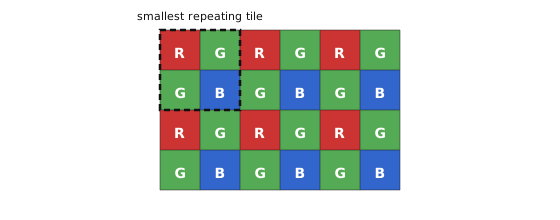
The Bayer colour filter array. Each cell of the sensor sees only one of the three primary colours; green appears in two of every four cells.
Green is doubled on purpose. Human vision is much more sensitive to green than to red or blue, and the perceived luminance of a scene is mostly carried by the green channel. Sampling green at twice the density of red and blue puts the resolution budget where the eye notices it most, and hides the chrominance softness that follows.
7.10.2. What each pixel records
A colour sensor still stores only one number per pixel – the count of photons that made it through that pixel’s colour filter. A red-filter cell records its red-channel value; the green and blue values at the same location are simply missing from the data. The same is true for green and blue cells.
The data that leaves the sensor in raw Bayer format is therefore one channel per pixel, laid out in the Bayer pattern, rather than the three channels per pixel of a finished colour image. Reconstructing the missing two channels at every cell position is called debayering.
7.10.3. Microlenses and the chief ray angle
The colour filter is not the only thing on top of the photodiode. Above it sits a tiny microlens that focuses the incoming light cone onto the photodiode’s active area, and the microlens is designed assuming the light comes in close to perpendicular to the sensor surface. When light arrives at a steep angle instead – the chief ray angle that grows toward the corners of every real lens – some of it can land on the neighbouring pixel’s filter instead, picking up the wrong colour and producing colour crosstalk. Corner pixels lose saturation as well, because part of the cone misses the photodiode entirely.
Sensors compensate by shifting each pixel’s microlens radially outward from the centre of the sensor, in concentric rings that expand from the middle out to the corners. The shift is zero at the centre and grows to a few microns at the outermost ring, tuned to a specific CRA profile baked into the sensor’s design. Pairing a sensor with a lens whose CRA profile differs substantially from the design target leaves visible colour and sensitivity errors in the corners, which is why image sensors and lenses are usually chosen together.