
 OpenMV MicroPython
7.1. The pinhole camera
Before there is a sensor there is an image to form, and the geometry of that image is set by whatever optical element sits in front of the sensor. The simplest such element is a pinhole – a single small opening in an otherwise opaque wall, and the conceptual ancestor of every camera lens.
7.1.1. Image formation
A scene has to be lit for there to be anything to image. Light from the sun, a lamp, or any other source hits the objects in the scene; each point on each object absorbs some of that light and scatters the rest in every direction. Those scattered rays are what the camera collects.
Most of the rays leaving any one scene point hit the wall of the box and stop; the handful that pass through the pinhole each travel in a straight line and strike the back of the box at a single point determined by the pinhole’s geometry.
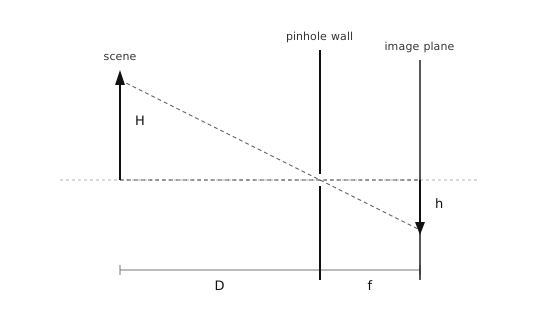
Each scene point projects through the pinhole onto a unique point on the back wall. Because the rays cross at the pinhole, the image is inverted.
Top and bottom swap, and left and right swap with them. Cameras un-swap both further down the pipeline so the final image looks right side up.
7.1.2. Projection geometry
Let \(f\) be the distance from the pinhole to the back wall and \(D\) the distance from the pinhole to a scene point of real height \(H\). A straight ray from the top of the scene point through the pinhole lands on the back wall at an image height
A 1 m-tall object 5 m away, viewed by a pinhole 25 mm from the back wall, projects to an image \(25 / 5000 = 1/200\) of its real size – a 5 mm-tall inverted arrow on the wall.
The distance \(f\) here is the camera’s focal length. It helps to meet the term in a setting where it is literally a length – the depth between the imaging plane and the element that focuses light onto it. Every lens that replaces this pinhole later will have a focal length too, and the same \(f / D\) projection scale will apply.
7.1.3. The aperture trade-off
A pinhole that is mathematically a point makes a perfectly sharp image of every scene point, but a point gathers no light – the image is invisibly dim. Drilling out the hole lets more light through, so the image is brighter, but each scene point now projects through to a spot the size of the hole rather than to a single point. The image gets brighter and blurrier at the same time, and there is no hole size that gives both a sharp and a bright image.
A lens removes the trade-off. It is a wider opening that also refocuses every ray entering it back to a single point on the wall, so the image is both bright (because the opening is wide) and sharp (because the rays still meet at one point). The next page introduces it in those terms.