
 OpenMV MicroPython
7.6. Rolling and global shutter
The sensor reads out its two-dimensional pixel grid one cell at a time. Two things about that read-out shape the recorded image: the order in which the pixels are scanned, and how each row’s exposure window lines up with that scan in time. The first is fixed by the silicon; the second comes in two established flavours that matter a lot for scenes that move.
7.6.1. Read-out order
Typical sensors start at the bottom-left pixel and scan rightward along that row, then advance up to the next row and scan rightward again, and so on until they finish at the top-right.
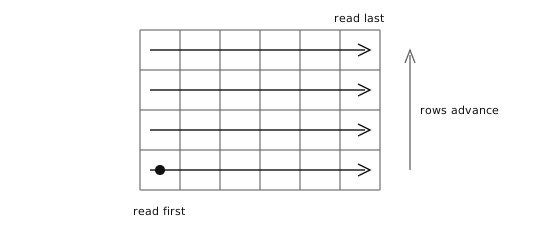
The pixel array is read out starting at the bottom-left pixel, scanning rightward along each row, and advancing up to the next row between rows.
The order is no accident. The lens horizontally mirrors and vertically flips the scene as it projects it onto the sensor – scene-top lands at sensor-bottom and scene-left at sensor-right – and the bottom-left-then-up read-out walks the sensor in the order that undoes both flips, putting the pixels into memory right-side up.
7.6.2. Rolling shutter
In a rolling-shutter sensor, each row is exposed and read out in turn. While one row is being read, the next is still finishing its exposure, the row after that has just started, and so on – each row’s exposure window is offset slightly in time from the next. The sensor’s integration window rolls across the frame in scan order, and a full scan takes the full frame period.
For stationary scenes this is invisible. For scenes with fast motion the offset shows up as a skew – an object that moves between the time the first row is captured and the time the last row is captured appears in different positions in different rows of the same frame.
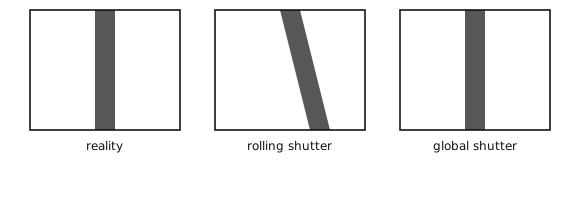
A vertical bar moving rightward, captured by each shutter type. Rolling shutter slants the bar because the top of the frame is read at a different time from the bottom; global shutter freezes the bar at one instant.
Rolling shutter is the cheaper design. Because each row is read promptly after it finishes exposing, the pixel circuit needs no per-pixel shielded storage to hold its value through a sensor-wide read-out. The transistors saved leave the photodiode a larger fraction of the pixel area, which translates directly into higher sensitivity and lower noise at the same physical pixel size. Most consumer image sensors are rolling-shutter for this reason.
7.6.3. Global shutter
In a global-shutter sensor, every pixel begins its exposure at the same instant and ends it at the same instant. The captured charge is then transferred into a shielded storage area on the pixel, and the row-by-row read-out happens from there. The captured frame represents one moment in time, no matter how fast the scene moves.
Global shutter costs more silicon, and the cost lands on the photodiode. Holding every row’s value through a sensor-wide read-out needs an extra shielded storage cell on each pixel plus the transistors that gate it off from the photodiode – area that would otherwise belong to the photodiode itself. A smaller photodiode catches fewer photons per unit time, so a global-shutter pixel is less sensitive than an equivalent-size rolling-shutter pixel. The same scene needs a longer exposure or higher gain to record at the same brightness, and the extra circuitry raises read-noise slightly on top of that.
The other tax is on exposure budget. In a rolling-shutter sensor each row’s exposure overlaps with neighbouring rows’ read-out, so every row can integrate light for very nearly the full frame period. In a global shutter the read-out cannot start until every row has finished exposing, so at a given frame rate the maximum exposure time is the frame period minus the full read-out time. For the same frame rate, the rolling-shutter pixel ends up with more light per frame.
These costs compound: global-shutter sensors are smaller in pixel count, noisier, less sensitive, and more expensive per pixel than their rolling-shutter counterparts. The trade is only worthwhile when fast motion has to be captured cleanly.
7.6.4. When to use which
The shutter type is a hardware property of the sensor, not a software setting. The choice is made when the camera is designed.
Rolling shutter is fine when:
the scene is stationary or moves slowly;
the application can tolerate some skew (most photography and most user-interface work);
cost and resolution per dollar are the priorities.
Global shutter is the right choice when:
the scene contains fast motion that has to be captured cleanly (robotics, drones, conveyor-belt inspection);
the camera itself is vibrating or moving relative to a static scene;
the image is fed into a vision algorithm that assumes each frame is a single time instant (most pose-estimation and structure-from-motion pipelines).
Note
The OpenMV Cam line defaults to global-shutter sensors for machine-vision use, where motion blur on a moving subject (or a moving camera) breaks downstream detection and tracking. Rolling-shutter sensor modules are also offered for applications where image quality of a slow or static scene matters more than freezing fast motion – classic photography-style capture.