
 OpenMV MicroPython
7.9. Sensor buses
A camera sensor and the MCU it talks to exchange two different kinds of data on two different buses.
7.9.1. Control bus
Every sensor setting lives in a register on the chip – pixel format, frame size, exposure time, gain, white-balance gains, auto-control targets, and so on. The MCU reads and writes those registers across an I2C bus (some sensors use SPI instead). Two wires (SCL and SDA) connect the MCU’s I2C peripheral to the sensor’s I2C interface, and every configuration the user picks is translated by the driver into one or more register writes on this bus.
The control bus runs at a relaxed speed – 100 kHz or 400 kHz typically. Setting one register takes tens of microseconds; reconfiguring the whole sensor (a reset, a fresh frame size, a fresh pixel format) takes tens to hundreds of milliseconds, mostly because the chip needs a moment to bring the new mode up to a clean state after each register write. None of that has to keep up with the pixel stream.
7.9.2. Pixel data bus
The pixel data leaves the sensor on a separate, wider, much faster bus. Two families dominate.
Parallel is the older of the two. It carries eight or ten data lines for the pixel bits, plus a pixel clock (PCLK), a line-valid signal (HSYNC), and a frame-valid signal (VSYNC). On each clock edge one pixel byte appears on the data lines; HSYNC and VSYNC tell the receiver where each row and each frame start and stop. Parallel buses are simple, but throughput is limited by how fast the MCU’s pin matrix can clock data in – typically a 50 to 100 MHz pixel clock at the high end.
MIPI CSI-2 – the Mobile Industry Processor Interface Camera Serial Interface, version 2 – has largely replaced parallel on new image sensors. It carries the pixels on one or more differential lane pairs at hundreds of megabits per second per pair, with a smaller pin count, much higher bandwidth, and lower EMI. Parallel persists mostly on legacy designs and on smaller, lower-rate parts where its simplicity still pays off.
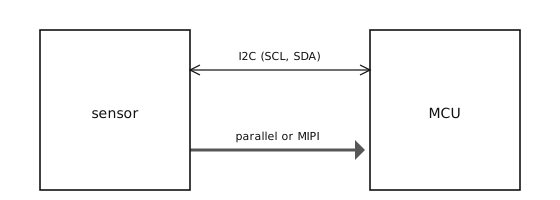
The sensor and the MCU exchange control on a slow bidirectional I2C bus and pixel data on a wider, faster, one-way parallel or MIPI bus.
Whichever family the sensor uses, the MCU side has a fixed-function peripheral that catches the incoming pixels and writes them into a framebuffer in memory. The Python code never drives this bus directly; it only reads the framebuffer once that hardware has finished filling it.