
 OpenMV MicroPython
7.4. Real-lens effects
The thin-lens model and the FOV formula match real lenses well near the centre of the frame. Off-centre, three physical effects show up that the sensor pipeline has to account for: straight lines in the scene curve on the sensor, corner pixels record the scene dimmer than centre pixels, and the rays converging onto each pixel arrive at an angle that depends on where the pixel sits.
7.4.1. Barrel and pincushion distortion
The thin-lens model says straight lines in the scene project to straight lines on the sensor. Real lenses bend off-axis rays slightly differently from what the model predicts, and the result is that straight lines in the scene curve gently on the sensor. The bending is radial – lines passing through the centre of the frame stay straight, but lines offset from the centre bow outward or inward.
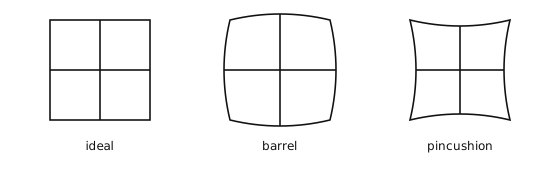
Left: an ideal frame. Middle: barrel distortion bulges the edges outward. Right: pincushion distortion bows them inward.
Two flavours of distortion show up in practice:
Barrel distortion bows lines outward from the centre, like the staves of a barrel. Short focal lengths (wide-angle lenses) are the usual culprit, and a fish-eye lens at the extreme is just severe barrel distortion.
Pincushion distortion pinches lines inward toward the centre, like the laces of a pincushion. Long focal lengths (telephoto lenses) tend to produce it, usually more subtly than wide-angle barrel.
Software can correct distortion after the fact, given a calibrated description of how a particular lens deviates from the ideal. The fix is a per-pixel coordinate remap from the distorted image back to where each ray would have landed without the bending.
7.4.2. Light falloff at the corners
A uniformly bright scene comes out brighter at the centre of the recorded image than at the corners. Three geometric effects compound multiplicatively. For a scene point at angle \(\theta\) from the optical axis:
1. The corner is farther from the lens than the centre. A point at angle \(\theta\) on the same scene plane sits at distance \(D / \cos\theta\) from the lens, against distance \(D\) for the on-axis point. The inverse-square law says intensity falls as the square of distance, so on its own this effect contributes
– two factors of \(\cos\theta\).
2. The lens aperture is foreshortened from the corner. Seen from the off-axis point, the aperture surface is tilted by angle \(\theta\) relative to the line of sight. Its projected area, and so the amount of light it collects, is reduced by \(\cos\theta\).
3. The sensor receives the light at an angle. Rays converging onto a corner pixel hit the sensor at angle \(\theta\) from the normal. The same light bundle spreads across a patch larger by \(1 / \cos\theta\), so per-area intensity drops by \(\cos\theta\).
The three effects multiply:
This is the cos⁴ falloff. For a wide-angle lens whose corner ray makes a 60° angle with the optical axis, \(\cos^4 60° = 0.0625\) – the corner records at about 6% of the brightness of the centre.
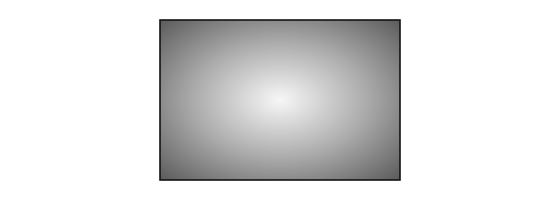
A uniformly lit scene comes out bright in the centre and dim at the corners, falling off as \(\cos^4(\theta)\) of the corner angle.
Mechanical vignetting from the lens housing – light clipped by the rim of the lens barrel or by the mount – adds to the geometric falloff and looks the same: darker corners. A common mitigation on the lens side is to pick a lens whose image circle is substantially larger than the sensor diagonal: the sensor then captures only the inner, better-corrected portion of the lens’s image, where the corner angle \(\theta\) is smaller and the \(\cos^4\) term is correspondingly less severe. The same choice helps with barrel distortion and chief ray angle at the corners, since all three effects worsen toward the edge of the image circle. Whatever falloff remains is handled by the on-sensor lens-shading correction (LSC), covered in on-sensor calibration.
7.4.3. Chief ray angle
A bundle of rays from a single scene point converges through the lens and lands on a single sensor pixel. The central ray of that bundle – the one passing through the centre of the lens aperture – is the chief ray. At the centre of the sensor (the optical axis), the chief ray arrives perpendicular to the sensor surface. At pixels away from the centre, the chief ray arrives at an angle.
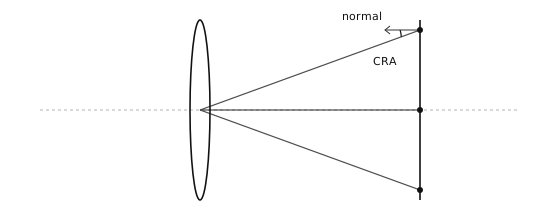
The chief ray for each pixel converges through the lens centre. The angle it makes with the sensor normal is the chief ray angle (CRA), zero on the optical axis and growing toward the corners.
The angle between the chief ray and the sensor normal at a given pixel is the chief ray angle, or CRA. CRA is zero at the centre of the sensor and grows toward the corners. The maximum value depends on the lens design – common values for small fixed-lens cameras range from about 15° to 30° at the corners.
CRA matters because sensor pixels respond best to light arriving close to perpendicular to the sensor surface. At steep angles the response drops off, and some of the light can leak between neighbouring pixels. Sensor designs accommodate a specific CRA profile – pairing a sensor with a lens whose profile differs substantially shows up as visible sensitivity and colour errors in the corners, which is why image sensors and lenses are usually chosen together.