
 OpenMV MicroPython
7.5. The pixel cell
A camera sensor is a two-dimensional grid of light-sensitive cells, one per pixel. Each cell is a small electrical circuit built around a photodiode that turns light into a voltage, which at the end of each frame is digitised into a single numerical pixel value.
7.5.1. The circuit
The active element in each cell is a photodiode – a small light-sensitive p-n junction in silicon. Under reverse bias the photodiode stores a small reservoir of charge that incoming photons can release, one little bit at a time.
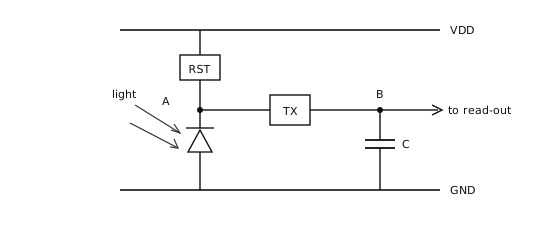
The pixel circuit: a photodiode with a reset switch that pre-charges it, a transfer switch that hands the exposed voltage to a small holding capacitor, and an output to the read-out amplifier.
7.5.2. The exposure cycle
Every cell follows the same four-step cycle each frame.
Precharge. The cycle begins with a brief reset pulse
that closes the reset switch RST, connecting the
photodiode to the supply rail and lifting its stored
voltage up to a known reference. The switch then opens,
leaving the photodiode isolated at the reset voltage with
its charge reservoir full.
Exposure. During the exposure window the photodiode is left to collect light. Each photon absorbed costs the photodiode a small amount of its stored charge. Light makes the stored charge disappear – the brighter the scene, the faster the photodiode discharges and the lower its voltage by the end of the window. The total drop is the pixel’s signal.
Sample. The exposure window ends with a brief pulse on
the transfer switch TX. While TX is closed the
photodiode’s remaining charge is dumped onto the small
holding capacitor C wired to node B. The voltage on
C now records the pixel’s measurement. TX then
opens again, locking the value on C and freeing the
photodiode to be reset for the next frame while C waits
for its turn at the read-out amplifier.
Read-out. The read-out amplifier feeds the voltage on
C to an ADC, which converts it to an integer count –
typically 10 to 12 bits of raw precision per pixel
(sometimes 14 in higher-end sensors). That count is the
raw pixel value. Everything else the pipeline does to the
image – corrections, debayering, colour grading, format
conversion – starts from this number, one per cell.
7.5.3. Saturation
The photodiode has a maximum amount of charge it can give up before its reservoir is fully drained. Past that point the pixel is saturated – additional light has no effect on the recorded voltage, and the cell reads its maximum value no matter how much brighter the scene gets.
The maximum amount the photodiode can lose before saturating is its full-well capacity. Larger physical pixels hold more stored charge and so have a higher full-well capacity, which is why sensors with smaller, more numerous pixels generally have a lower dynamic range than their lower-resolution counterparts.