
 OpenMV MicroPython
7.3. Field of view
A camera sees a cone of the world in front of it; everything outside that cone falls off the side of the sensor. The angular width of that cone is the field of view (FOV), and it is determined by two numbers – the sensor size and the lens focal length.
7.3.1. The FOV formula
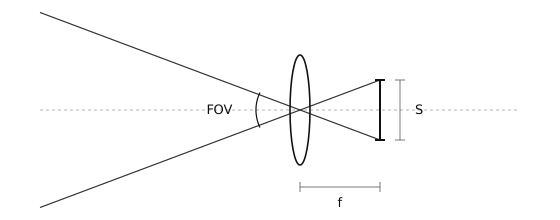
A sensor of width \(S\) at distance \(f\) behind the lens defines a cone of incoming rays. The full angle of that cone is the field of view.
A sensor of width \(S\) sits at distance \(f\) behind the lens, perpendicular to the optical axis. The thin-lens model says a ray through the centre of the lens continues undeflected, so trace one such ray from each edge of the sensor: each one heads straight through the lens centre and out into the scene on the far side. Together they bound the cone of light the sensor can collect, and the angle between them at the lens is the field of view.
Half of that cone is a right triangle. One leg is the optical axis from the lens centre to the centre of the sensor – length \(f\). The other leg is the half-sensor from the sensor centre out to one edge – length \(S / 2\). The hypotenuse is the ray itself, running from the lens centre to the sensor edge.
The Pythagorean theorem ties the three side lengths together, but Pythagoras does not give angles, and the angle at the lens vertex is what we are after. Trigonometry is the bridge from side ratios to angles. In any right triangle, the tangent of an angle is defined as its opposite side over its adjacent side. For the half-FOV angle, the opposite side is the half-sensor \(S / 2\) and the adjacent side is the optical-axis leg \(f\), so
The angle itself comes out by applying the inverse of the tangent – the arctangent function – to both sides:
The cone is symmetric about the axis, so the full FOV is twice the half-angle:
Two consequences fall out of the formula:
The lens focal length sets the angle, not the absolute size. A “wide-angle” lens is wide because its focal length is short – the smaller \(f\) is, the larger the ratio \(S / 2f\) becomes, and the wider the cone. A long focal length narrows the cone (a “telephoto” lens).
The sensor size matters too. Mounting the same lens in front of a smaller sensor crops the cone – the same lens has a narrower field of view on a smaller sensor than on a larger one. This is why focal length numbers on different cameras are not directly comparable; the FOV depends on both \(f\) and \(S\).
7.3.2. Three lens choices
Take a 4.8 mm × 3.6 mm sensor (a common small-format size roughly matching what OpenMV Cam sensors deliver) and three lens choices.
focal length |
diagonal FOV |
horizontal FOV |
vertical FOV |
description |
|---|---|---|---|---|
2.8 mm |
~94° |
~81° |
~66° |
wide angle |
4 mm |
~74° |
~62° |
~48° |
normal |
8 mm |
~41° |
~33° |
~25° |
narrow / tele |
All three columns go through the same formula. The diagonal FOV uses \(S\) equal to the sensor diagonal \(\sqrt{W^2 + H^2}\) (6 mm for this sensor); the horizontal FOV uses \(S = W = 4.8\) mm; the vertical FOV uses \(S = H = 3.6\) mm. Halving the focal length nearly doubles each cone; doubling it nearly halves them.
Lens datasheets usually publish the diagonal FOV as the single headline number, since it spans the sensor corner to corner. The horizontal and vertical FOVs are more directly useful when planning what will fit in the frame, because the frame is rectangular and a rectangular working area is bounded along the horizontal and vertical, not the diagonal.
7.3.3. Choosing a focal length
The FOV the application needs is set by how big a region the camera has to see and how far away the camera will be. If the camera sits 1 m above a 0.6 m × 0.6 m work area, the angular FOV needed to cover one edge is \(2 \cdot \arctan(0.3 / 1) \approx 33°\), and the 8 mm lens above comes close.
Going wider than the application needs makes objects smaller in the frame, wastes pixels on background, and increases lens distortion. Going narrower drops parts of the scene off the side of the sensor. The right lens is the longest focal length that still covers the working area at the camera’s intended distance.