
 OpenMV MicroPython
7.2. Lenses and focus
A pinhole works but is dim. A lens replaces the pinhole with a wider aperture and refocuses every ray entering it back to a single point on the image plane, so the image is both bright and sharp – the trade-off the pinhole forced disappears.
7.2.1. Refraction
Light slows down when it enters a denser medium (glass) from a lighter one (air), and the change of speed at the interface bends the ray. A lens is a piece of glass shaped so that every ray from a given scene point bends by exactly the amount needed to converge again at the same point on the back wall. Rays from a different scene point converge at a different point, and so on; the image is built up one scene point at a time, exactly like the pinhole’s, but with vastly more light per point.
7.2.2. The thin-lens model
Real lens design accounts for glass shape, multiple elements, and the wavelength of light passing through them. The geometry the rest of this section needs comes from a simpler idealisation – the thin-lens model – which treats the lens as a vertical plane on the optical axis where rays change direction instantaneously, ignoring the lens’s actual thickness.
The model is anchored by one starting observation: rays arriving at the lens parallel to the optical axis all refract to pass through the same point behind the lens. That point is the focal point, and its distance from the lens is the lens’s focal length, conventionally written \(f\). A “50 mm lens” is one whose focal length is 50 mm. Every lens has two focal points, one on each side, at equal distance \(f\) – the one on the image side and one symmetrically on the object side.
From that single fact, two ray-tracing rules drop out and let the model locate any image point:
A ray entering the lens parallel to the axis refracts to pass through the far focal point on the image side.
A ray passing through the centre of the lens continues straight, undeflected – because at the centre the lens is thin enough that there is effectively no glass to bend the ray.
Those rules might look like the description of a single ray-trace, but they describe what the lens does at every scene point at the same time. Each visible point scatters light in every direction; whichever of its rays enter the lens converge again at that point’s image on the far side. The complete picture is the union of millions of those per-point convergences, all happening in parallel.
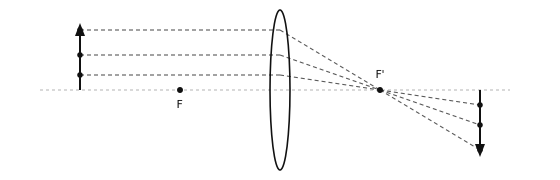
The same parallel-to-focal-point rule applies at every point of the object. Each scene point produces its own image point on the far side; together they trace out a complete inverted image.
Zooming in on a single scene point makes the construction explicit. Two rays leaving that scene point – one parallel to the axis (refracted through the far focal point) and one through the centre of the lens (undeflected) – cross again on the far side of the lens, and where they cross is the image of that point.
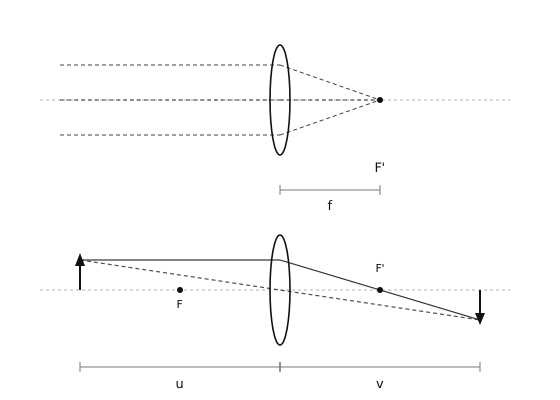
Top: parallel rays converge at the focal point. Bottom: the two construction rays from a scene point locate its image on the far side of the lens.
The same geometry expressed algebraically is the thin-lens equation. It relates object distance \(u\), image distance \(v\), and focal length \(f\):
Given any two of the three, the equation gives the third.
For a very distant scene (\(u\) large), the term \(1/u\) becomes negligible and \(v\) approaches \(f\) – distant scenes focus at the focal point. Closer scenes need \(v\) larger than \(f\), meaning the lens has to sit farther from the sensor to stay in focus. That is what every focusing mechanism – manual barrel, autofocus motor, fixed-focus shim – is physically doing: shifting the lens back and forth so \(v\) matches the \(u\) of the scene the camera is asked to image sharply.
7.2.3. Depth of field
A lens focused at one object distance only forms a perfectly sharp image of points at exactly that distance. Points nearer or farther focus to spots in front of or behind the sensor and arrive at the sensor as small blur circles. The range of object distances over which those blur circles are small enough to look sharp is the depth of field (DOF).
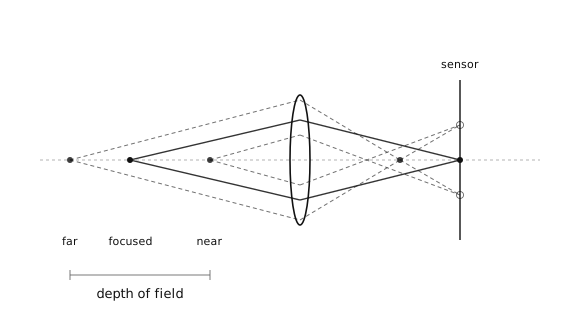
Only points at the focused distance project to true points on the image plane; nearer and farther points arrive as blur circles. The range of acceptable blur is the depth of field.
Depth of field grows when the lens is stopped down – a smaller hole admits a narrower bundle of rays from each scene point, and those narrower bundles produce smaller blur circles for off-focus points. So a smaller aperture gives more DOF but admits less light, and a larger aperture admits more light but cuts DOF. Aperture is the second knob the lens hands the photographer, and like the pinhole/lens choice before it, it is a sharpness-vs-brightness trade.
7.2.4. Aperture and F-number
Lens apertures are expressed as F-numbers, the ratio of the focal length to the aperture diameter:
where \(D\) is the diameter of the opening. A 50 mm lens
with a 25 mm-wide opening has \(N = 2\), written f/2.
Smaller F-numbers mean a wider opening (more light, less DOF);
larger F-numbers mean a narrower opening (less light, more
DOF). The ratio rather than absolute diameter is what matters
because the same \(f / D\) ratio gives the same image
brightness for the same scene, regardless of focal length.
The OpenMV Cam’s stock lenses come with fixed apertures chosen for general-purpose use; the F-number is one of the specs given in the lens datasheet. Aperture matters less day-to-day than focal length on these cameras, but the concept matters to read a datasheet.