
 OpenMV MicroPython
6.11. Debouncing
A switch is drawn as a perfect open-or-closed contact, but a real switch’s contacts do not snap cleanly between the two states. They chatter – make and break electrical contact many times within a few milliseconds before settling. A GPIO input reading the pin sees that as a burst of edges; a careless polling loop counts several “presses” for one real press, and an interrupt handler runs several times per actual press.
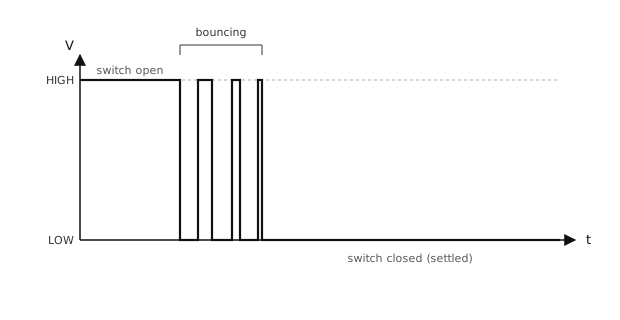
A bouncing switch produces a burst of fast transitions before settling.
Debouncing is the practice of filtering the chatter so that each physical press registers as a single event. Two approaches solve this – software (a timing rule in firmware) or hardware (a small filter on the wire). They are not mutually exclusive.
6.11.1. Software debouncing
The idea is to remember when the input last changed and reject further changes within a short window of that timestamp. Contact bounce typically lasts under 10 ms; a real press takes 50 – 100 ms; a 30 – 50 ms window catches all bounces without blocking real presses.
In a polling loop, read the pin, compare to the last stable value, and only accept a change after the debounce window has elapsed:
import time
from machine import Pin

button = Pin("P0", Pin.IN, Pin.PULL_UP)
last_state  = 1
last_change = 0
DEBOUNCE_MS = 50

while True:
    now = time.ticks_ms()
    state = button.value()
    if state != last_state and time.ticks_diff(now, last_change) > DEBOUNCE_MS:
        last_change = now
        last_state = state
        if state == 0:
            do_action()
    time.sleep_ms(10)
For interrupt-driven reads, apply the same timing rule inside
the handler, then hand the real press off to main context via
micropython.schedule() (see GPIO input):
import time
import micropython
from machine import Pin

button = Pin("P0", Pin.IN, Pin.PULL_UP)
last_irq = 0
DEBOUNCE_MS = 50

def handle_press(pin):
    do_action()

def on_press(pin):
    global last_irq
    now = time.ticks_ms()
    if time.ticks_diff(now, last_irq) < DEBOUNCE_MS:
        return
    last_irq = now
    micropython.schedule(handle_press, pin)

button.irq(handler=on_press, trigger=Pin.IRQ_FALLING)
The ISR filters bounces by timestamp and queues the callback;
handle_press runs back in main context, where allocation
and slow I/O are safe.
6.11.2. Hardware debouncing
Hardware debouncing filters the chatter electrically, before it ever reaches the pin. The standard tool is a capacitor.
A capacitor is a two-terminal component that stores electric charge. Physically, it is two conductive plates held a short distance apart, separated by an insulator (the dielectric).
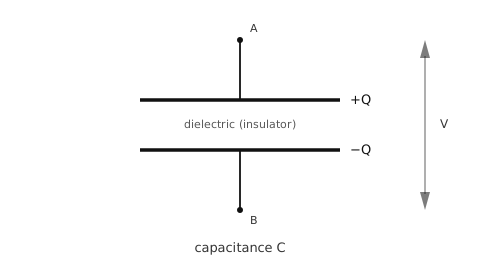
A parallel-plate capacitor: two conductors separated by an insulating layer.
Applying a voltage across its terminals drives equal and opposite charges onto the two plates; the relationship is
Q = C × V
where Q is the stored charge (coulombs), V is the
voltage across the capacitor, and C is its capacitance
(farads). Capacitance is fixed by the device’s construction;
more capacitance means more charge stored at the same voltage.
The consequence: a capacitor cannot change its voltage instantly. Charge flowing in or out has to pass through whatever resistance is in the path, and that resistance sets how fast the voltage can change.
6.11.2.1. RC time constant
Charging a capacitor through a resistor produces a smooth exponential rise toward the supply voltage, not a step. The characteristic time of that rise is the RC time constant:
τ = R × C
After one τ, the capacitor has reached about 63 % of the
supply voltage. After 5 τ, it is over 99 % – “fully
charged” for practical purposes.
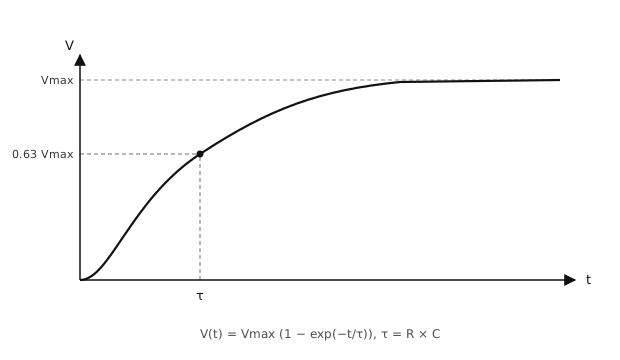
A capacitor charges along an exponential curve. τ = RC
is the time to reach 63 % of the final voltage.
Discharging through a resistor follows the mirror image: the
voltage falls exponentially from its initial value toward
zero, dropping to 37 % of the starting voltage after one
τ, and to under 1 % after 5 τ.
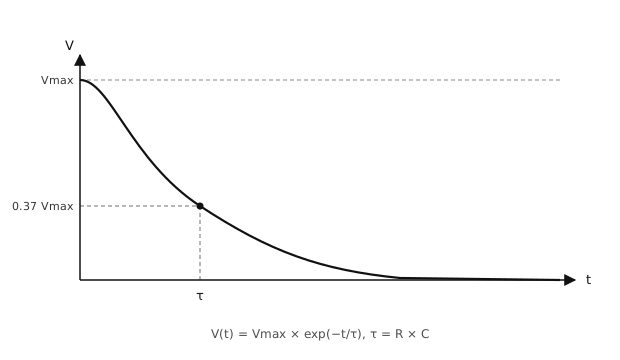
A capacitor discharges along an exponential decay.
τ = RC is the time to fall to 37 % of the starting
voltage.
6.11.2.2. The debounce circuit
A capacitor between an input pin and ground, fed through a series resistor, forms a low-pass filter. Fast spikes do not have time to charge or discharge the capacitor through that resistor; the pin stays close to whatever voltage it was at before the spike. Slow changes – a deliberate press – charge or discharge the capacitor and the reading follows.
R1 pulls the switch’s high side up to Vcc, producing a
raw switch signal that bounces. R2 and C then
low-pass-filter that signal into the pin:
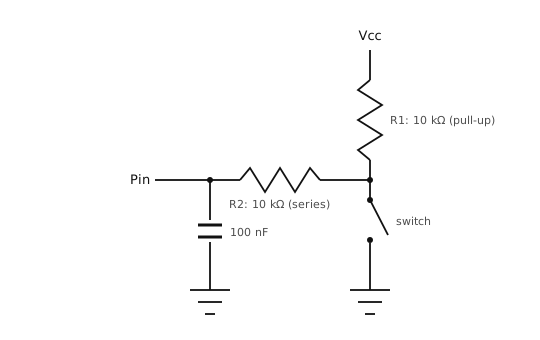
Hardware debouncing: R2 and C low-pass-filter the
raw switch signal before it reaches the pin.
Typical values: R1 = 10 kΩ (pull-up), R2 = 10 kΩ
(series), C = 100 nF.
When the switch is open, current flows Vcc → R1 → R2
→ cap (in series), charging the cap to Vcc with
τ_charge = (R1 + R2) × C = 2 ms.
When the switch closes, the switch node clamps to ground and
the cap drains through R2 alone to that ground with
τ_discharge = R2 × C = 1 ms.
Both edges are RC-filtered. Because the cap sits on its own
node, downstream of R2 from the switch, it swings cleanly
between Vcc (open) and 0 V (closed) – no current has to flow
through R1 at steady state in either case.
6.11.3. Choosing between them
Software is the default. It costs nothing in components, the threshold is easy to tune, and it works on any pin that the CPU reads.
Hardware is worth the parts when the bounce reaches something other than the CPU’s polling code – an interrupt that must not double-fire, a hardware counter, a peripheral with no filter of its own.
Software and hardware debouncing also coexist peacefully: a small RC filter suppresses the worst spikes, and a software debounce window covers what is left.