
 OpenMV MicroPython
6.17. Bit streams and pulse measurement
Some devices need precisely-timed pulse patterns rather than a constant-frequency PWM signal. A WS2812 RGB LED encodes each bit as a pulse of a specific width; an HC-SR04 ultrasonic ranger answers with an echo pulse whose width is the round-trip flight time; an IR remote sends a header followed by data bits as on-off sequences.
The machine module has two functions for this kind of
timing-precise GPIO:
bitstream()sends a pulse train with a separate timing for0and1bits.time_pulse_us()measures the width of an incoming pulse in microseconds.
6.17.1. Sending a bit stream
machine.bitstream() takes a pin, an encoding, a timing
specification, and the bytes to send. The most common
encoding (0) is high-low pulse-duration modulation:
each bit is a high pulse of one width followed by a low pulse
of another, with 0 and 1 bits having distinct timings.
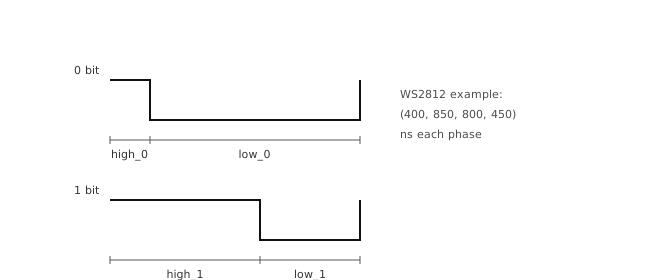
The high-low pulse-duration encoding: a 0 and a 1
each consist of a high phase followed by a low phase, with
distinct widths.
The canonical example is the WS2812 (NeoPixel) RGB LED, which expects bits at 800 kHz with these timings:
0: 400 ns high, then 850 ns low.1: 800 ns high, then 450 ns low.
from machine import Pin, bitstream

pin = Pin("P7", Pin.OUT)

# (high_0, low_0, high_1, low_1) in nanoseconds
timing = (400, 850, 800, 450)

# one LED: GRB order, three bytes per LED (red shown here)
bitstream(pin, 0, timing, b"\x00\xff\x00")
The MCU bit-bangs the pulses at the requested widths; on cams fast enough for it the timing is accurate to within tens of nanoseconds.
Warning
bitstream() disables all interrupts for the
entire transmission so it can keep precise control over the
pulse timing. The call duration scales linearly with the
number of bytes – at WS2812 timing (about 10 µs per byte),
sending 100 bytes pauses the CPU for around 1 ms, 1000
bytes for 10 ms, and 10000 bytes for a full 100 ms.
Anything beyond a few hundred bytes per call risks
noticeable lock-ups – break long updates into smaller
chunks, with the call returning between each chunk so the
rest of the script can run.
Note
For driving WS2812 / NeoPixel strips in particular, the
neopixel module wraps bitstream() in
a higher-level interface that handles colour-order
shuffling and bulk strip updates. Reach for
bitstream() directly when the protocol is
not WS2812 but still fits a high-low PDM shape.
6.17.2. Measuring an incoming pulse
machine.time_pulse_us() measures the width of a single
pulse on a pin. It waits for the line to reach the specified
level (the start of the pulse), then measures how long the
line stays at that level (the end of the pulse), and returns
the duration in microseconds.
The classic use is an HC-SR04 ultrasonic distance sensor. The camera sends a 10 µs trigger pulse, then waits for the echo pin to return a pulse whose width is the round-trip time of the sound:
import time
from machine import Pin, time_pulse_us

trigger = Pin("P7", Pin.OUT, value=0)
echo    = Pin("P8", Pin.IN)

while True:
    trigger.value(1)
    time.sleep_us(10)
    trigger.value(0)

    width = time_pulse_us(echo, 1, timeout_us=30_000)
    if width > 0:
        # sound at ~343 m/s; round trip / 2 / 343 = distance (m)
        distance_cm = (width * 343) / 2 / 10_000
        print(distance_cm, "cm")

    time.sleep_ms(100)
The third argument is the timeout in microseconds, applied
separately to “wait for the pulse to start” and “wait for the
pulse to end”. On timeout the function returns a negative
value identifying which phase failed: -2 if the pulse
never started, -1 if it started but never ended within
the window.
Both halves of the timeout matter for real sensors. An HC-SR04
can take one to two milliseconds to start its echo, and the
echo itself can be tens of milliseconds long for far objects.
Sizing timeout_us to the maximum range needed keeps the
measurement bounded.