
 OpenMV MicroPython
6.16. Servo control
A hobby (RC) servo is a small geared motor in a sealed case with closed-loop position control built in. Inside the case sits a DC motor, a reduction gearbox, a potentiometer connected to the output shaft, and a small driver board that compares the pot’s reading against a setpoint coming in from outside. The driver runs the motor in whichever direction reduces the error, and stops when the position matches. From the camera’s side none of that is visible – you just tell the servo where to go.
6.16.1. The PWM signal
A servo takes its setpoint as a PWM signal at a fixed 50 Hz frame rate, where the pulse width selects the position:
A 1.0 ms pulse drives the shaft to one end of its travel.
A 1.5 ms pulse parks the shaft at the centre.
A 2.0 ms pulse drives the shaft to the other end.
Anything in between maps to an intermediate position.
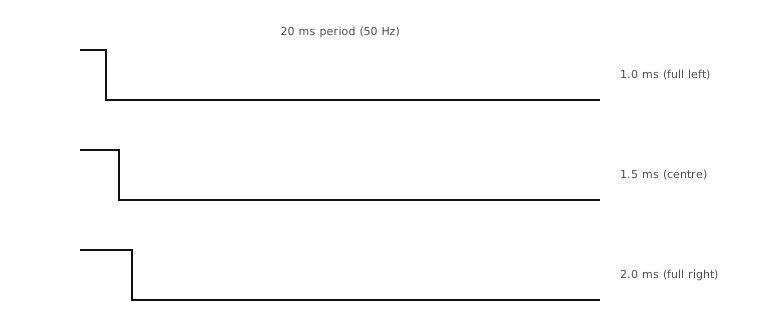
The servo’s PWM frame is 20 ms long; the pulse width (1.0 – 2.0 ms) selects the position.
Unlike LEDs and motors, the servo does not average the PWM. The pulse width itself is the command: the servo’s internal logic measures each pulse, sets its target accordingly, and runs the motor until the output matches. The duty cycle as a fraction (between 5 % and 10 % across the full range) is incidental – it is the absolute pulse width that matters, which is what software needs to control.
6.16.2. Wiring
Hobby servos use a three-wire connector:
Power (commonly red): the servo’s own supply, typically 4.8 V to 6 V. Do not power the servo from the camera’s 3.3 V rail – it cannot supply the stall current, and the rail will brown out.
Ground (commonly black or brown): the return path for the servo’s power, tied to the camera’s ground so the signal also has a shared reference.
Signal (commonly white, yellow, or orange): the PWM line from the camera’s GPIO.
6.16.3. Code
duty_u16() would work, but it sets the duty
as a fraction of the period – awkward for a signal where the
absolute pulse width is what matters and the period is fixed.
duty_ns() sets the pulse width directly in
nanoseconds:
from machine import PWM, Pin

servo = PWM(Pin("P7"), freq=50, duty_ns=1_500_000)  # centre
The carrier is 50 Hz (20 ms period); the high time on each cycle is exactly 1500 µs. A small helper makes the position-to-pulse mapping explicit:
def set_position(angle):
    # angle: 0..180 degrees mapped to 1.0..2.0 ms
    pulse_us = 1000 + (angle * 1000) // 180
    servo.duty_ns(pulse_us * 1000)

set_position(0)      # full one way
set_position(90)     # centre
set_position(180)    # full the other way
A slow sweep across the range:
import time

for angle in range(0, 181, 5):
    set_position(angle)
    time.sleep_ms(20)
for angle in range(180, -1, -5):
    set_position(angle)
    time.sleep_ms(20)
The 1.0 – 2.0 ms range is the standard, but many servos accept a wider range (often 500 µs to 2500 µs) for full travel. The servo’s data sheet lists the exact pulse-width limits; numbers outside that range can slam the motor into its mechanical stops.
For a servo with a non-standard range, lift the limits into constants and parameterize the mapping:
PULSE_MIN_US = 500     # full one way (from the data sheet)
PULSE_MAX_US = 2500    # full the other way

def set_position(angle):
    span_us = PULSE_MAX_US - PULSE_MIN_US
    pulse_us = PULSE_MIN_US + (angle * span_us) // 180
    servo.duty_ns(pulse_us * 1000)