
 OpenMV MicroPython
6.15. DC motor control
A DC brushed motor is a coil of wire on a shaft inside a magnetic field. Pass current through the coil and the field exerts a force on it; the force becomes torque on the shaft. Brushes inside the motor switch the current direction in the coil as the shaft turns, so the torque always pushes the shaft in the same direction. Apply a DC voltage across the two motor leads and the shaft spins; swap the polarity and it spins the other way.
Motors typically want hundreds of milliamps to several amps, at supply voltages above the camera’s 3.3 V logic rail. A GPIO pin can source on the order of 25 mA and cannot reverse polarity – it can only drive its two rails. The drive stage between the camera and the motor has to carry the motor’s current, route a separate higher-voltage motor supply, and let the camera reverse the polarity on command. The four-transistor H-bridge is the standard answer.
6.15.1. The H-bridge
An H-bridge is four switches arranged in an H around the motor:
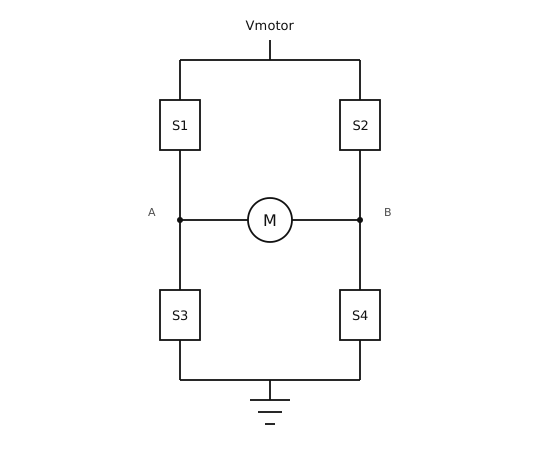
The H-bridge: four switches (S1 – S4) connect the
motor M between Vmotor and ground.
Closing different pairs of switches selects what the motor sees at its leads:
S1 + S4 closed, S2 + S3 open. Current flows from Vmotor through
S1, intoA, across the motor toB, and throughS4to ground. The motor turns one way.S2 + S3 closed, S1 + S4 open. Current flows the other way through the motor. The motor turns the other way.
All four open. Both motor leads float; the motor coasts.
S3 + S4 closed (or S1 + S2 closed). Both motor leads are tied to the same rail; the motor’s own kinetic energy drives a current that the closed pair shorts out as heat. The motor brakes.
The illegal combination is closing both switches in the same
column – S1 + S3 or S2 + S4 – which forms a short
circuit from Vmotor straight to ground. This is shoot-through,
and the camera’s code must not allow it.
In practice the four switches are MOSFETs (introduced on the Level shifting page) inside an integrated driver IC. The chip exposes two or three logic-level input pins that map internally to the four switches and includes interlock logic that prevents shoot-through, so the camera’s code does not have to manage it directly.
6.15.2. PWM and the motor’s inductance
Setting the motor’s speed needs more than full-on and full-off. The trick is the same one used for LEDs in LED dimming with PWM: pulse the drive at a high frequency and let the load average the result. For an LED the averager was the eye; for a motor it is the coil itself.
A motor coil has substantial inductance. The current through an inductor cannot change instantaneously; it changes at a rate proportional to the voltage across it. Pulsing the bridge on and off at 20 kHz ramps the coil current up during each on-phase, and during the off-phase the current has to keep flowing – the coil reverses the voltage across itself to maintain it.
Without somewhere to go, that current would spike the voltage across the just-opened switch upward and could damage the transistor. Freewheeling diodes across each switch – often just the MOSFETs’ own body diodes inside the driver chip – give the current the path it needs. It flows through a diode and back around through one of the still-closed switches, completing a freewheel loop in which the current decays gradually through the small resistances of the bridge and the motor itself. The diode also pins the voltage across the opened switch within a diode drop of whichever rail the loop returns to, well inside the MOSFET’s safe operating area.
The current’s average over each PWM period is what produces
torque, and that average tracks the duty cycle linearly –
doubling the duty roughly doubles the torque, and at constant
load roughly doubles the speed. Unlike LED dimming, where the
eye’s non-linear response calls for a curve, a linear sweep of
duty_u16 already corresponds to a linear sweep of motor
effort.
The PWM frequency only has to clear two thresholds:
Above ~20 kHz the carrier is outside the human audible band. Below that, the magnetic force on the coil ramps up and down with each PWM pulse and the windings and laminations physically vibrate at the carrier frequency – the motor effectively becomes a small speaker emitting a tone at the PWM pitch.
Far above ~50 kHz the MOSFETs and their gate drivers start losing efficiency to switching losses. During each on-off transition the MOSFET briefly carries both significant voltage and significant current, dissipating a small burst of power as heat; the MOSFETs’ gate capacitance also has to be charged and discharged each cycle, which the driver chip pays for. Both costs scale with PWM frequency, so at high rates the heat from switching can rival the heat from conducting the motor current.
20 kHz is the comfortable default for hobby-size motors.
6.15.3. Driving an H-bridge
A two-input H-bridge driver chip maps IN1 and IN2 to
the four switches roughly like this:
IN1 = 0, IN2 = 0– coast (all four switches open).IN1 = 1, IN2 = 0– drive one direction.IN1 = 0, IN2 = 1– drive the other direction.IN1 = 1, IN2 = 1– brake.
Driving the two inputs as PWM outputs lets the camera set the direction by choosing which of the two pins carries the duty, and the speed by the duty value itself:
import time
from machine import PWM, Pin

in1 = PWM(Pin("P7"), freq=20_000, duty_u16=0)
in2 = PWM(Pin("P8"), freq=20_000, duty_u16=0)

def drive_a(speed):       # speed: 0..65535
    in1.duty_u16(speed)
    in2.duty_u16(0)

def drive_b(speed):
    in1.duty_u16(0)
    in2.duty_u16(speed)

def coast():
    in1.duty_u16(0)
    in2.duty_u16(0)

def brake():
    in1.duty_u16(65535)
    in2.duty_u16(65535)

drive_a(32768)    # half speed in direction A
time.sleep(2)
drive_b(16384)    # quarter speed in direction B
time.sleep(2)
coast()
A ramp from off to full and back gives a smooth start and stop:
for d in range(0, 65535, 256):
    in1.duty_u16(d)
    time.sleep_ms(10)
for d in range(65535, 0, -256):
    in1.duty_u16(d)
    time.sleep_ms(10)
6.15.4. Direction-and-speed drivers
A second family of H-bridge chips exposes a more convenient
interface: one digital direction input (often labelled
DIR or PH for “phase”) plus one speed input (often
PWM or EN for “enable”). The direction pin picks which
way the bridge drives; the duty cycle on the speed pin sets
the average current.
This is easier to drive from software than the
two-PWM-input scheme. The two signals match how the problem is
usually phrased – “turn this way, at this speed” – so the
code can say set_direction(forward); set_speed(50) instead
of branching between in1 and in2. Only one PWM channel
is needed, which frees the other channel on the same timer for
an unrelated job. And the direction pin can stay parked between
changes without retriggering the bridge, so changing speed at a
fixed direction touches only one register.
import time
from machine import PWM, Pin

dir_pin = Pin("P8", Pin.OUT)
speed = PWM(Pin("P7"), freq=20_000, duty_u16=0)

def drive(direction, speed_u16):
    dir_pin.value(direction)         # 0 or 1
    speed.duty_u16(speed_u16)        # 0..65535

drive(0, 32768)     # direction A at half speed
time.sleep(2)
drive(1, 16384)     # direction B at quarter speed
time.sleep(2)
speed.duty_u16(0)   # stop
What “stop” actually does on this kind of driver – coast or brake – depends on the chip. With a two-input driver the camera’s code chooses (both inputs low for coast, both high for brake); with a direction-and-speed driver the chip decides, so the data sheet is worth a glance before relying on either behaviour.