
 OpenMV MicroPython
6.8. Level shifting
A GPIO pin on the camera drives about 3.3 V when high. A device on the other side may run at 5 V (older microcontrollers, many sensor boards) or 1.8 V (newer sensors, some chip-to-chip buses). Connecting the two directly is sometimes safe and sometimes destructive; level shifting is the circuit that bridges the gap reliably.
6.8.1. Why direct cross-voltage drive can hurt a pin
Every chip’s I/O pad has a pair of built-in protection diodes: one from the pin to ground, one from the pin to the chip’s supply rail. They are there to absorb electrostatic discharge (ESD) – a brief, high-voltage spike from static electricity that can hit a pin when the board is handled. A person who has walked across a carpet can carry several kilovolts of static; touching the wrong pin transfers that charge to the chip in nanoseconds. The upper protection diode forward-biases and shunts the pulse safely into the supply rail before it reaches the transistors inside the chip.
When a 5 V signal is applied continuously to a 3.3 V pin that is not 5 V-tolerant, the upper protection diode conducts forever. The diodes are sized for short ESD pulses, not steady-state current; the supply rail starts rising above 3.3 V, the diode heats up, and either the pin or the on-chip voltage regulator fails.
5 V-tolerant pins use a different input stage – the upper diode goes to a higher rail or is absent – so applying 5 V is harmless. Whether a board’s pins are 5 V-tolerant varies by board; check the OpenMV Cam quick reference.
The other direction has its own problem. A 3.3 V GPIO driving
high produces ~3.3 V on the wire. A 5 V receiver that needs
0.7 × Vcc to recognise high sees its threshold at
3.5 V; 3.3 V may read as low or as ambiguous. Even with no
damage, the signal does not work reliably.
A level shifter solves both directions.
6.8.2. The N-MOSFET as a switch
The circuits below use a single N-channel MOSFET. It has three pins – gate, drain, and source – and behaves as an electrically-controlled switch.
The control input is the voltage between the gate and the
source, written Vgs (gate-to-source voltage):
Vgs = (gate voltage) - (source voltage)
The MOSFET cares about this difference, not the absolute
voltage on either pin alone. Its behaviour follows from
Vgs:
When
Vgsis above the MOSFET’s threshold voltage (typically around 1 V for a small-signal logic-level part), the transistor turns on and current flows freely from drain to source.When
Vgsis at or below 0, the transistor turns off and almost no current flows from drain to source.
The drain-source path is the switched current path; Vgs
opens or closes that switch.
An N-MOSFET also has a body diode between drain and source that conducts when the drain is pulled below the source by more than ~0.6 V. The diode is a side-effect of the manufacturing; the bidirectional shifter below uses it on purpose.
6.8.2.1. Wiring rules
An N-MOSFET is not a symmetric three-terminal device. The
body diode points from source (anode) to drain (cathode), and
Vgs is what controls the channel. Two rules follow and
must hold for every N-MOSFET switch circuit:
Source goes to the lower voltage; drain goes to the higher. With drain at the higher rail the body diode is reverse-biased and does nothing. Swap them and the body diode is forward-biased all the time: current flows from the now-higher source through the body diode to the now-lower drain regardless of what the gate is doing. The MOSFET stops being a switch – it leaks continuously, the signal cannot be turned off, and the device often overheats and fails.
The gate ties to the source’s voltage rail. Holding the gate at the rail the source sits on at rest makes
Vgs = 0at idle, well below threshold; the MOSFET stays firmly off until something either drives the gate above the source (the one-way circuit below) or pulls the source below the gate (the bidirectional circuit). Float the gate somewhere else and the off state stops being defined – noise, leakage, or stray capacitance can driftVgsabove threshold and switch the MOSFET on at random.
Reversing either rule turns the level shifter into a leaky, unreliable path. Both shifter circuits below follow these rules: source on the lower side, drain on the higher, gate tied or driven from the source’s rail.
6.8.3. One-way 3.3 V → 5 V
The simplest level shifter pushes a one-direction signal from the camera’s GPIO into a 5 V input. A single N-MOSFET plus two resistors does the job.
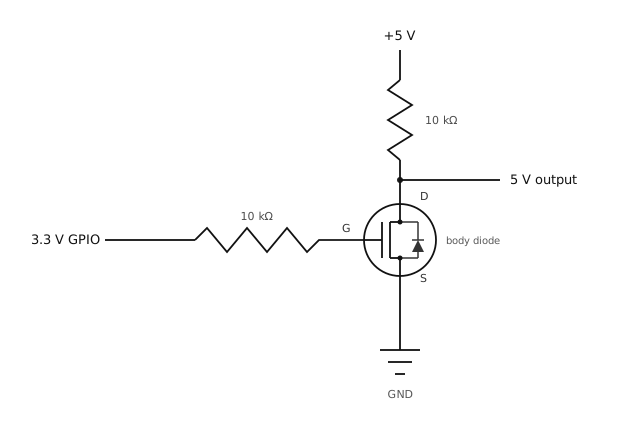
An N-MOSFET level-shifts (and inverts) a 3.3 V signal to a 5 V output.
When the GPIO drives high (3.3 V at the gate), Vgs is
above the threshold and the MOSFET turns on; the drain is
pulled down to ~0 V. When the GPIO drives low (0 V at the
gate), the MOSFET is off and the 10 kΩ pull-up brings the
drain to 5 V.
The output is the inverse of the input. Software can flip
the signal back (write 0 for “5 V output high”), or
cascade two stages to get a non-inverted signal at twice the
component count.
6.8.4. Bidirectional with one N-MOSFET
For a line that must be driven from either side – a shared bus where either end can pull the line low – the standard circuit is a single N-MOSFET per line, with one pull-up to each side’s supply.
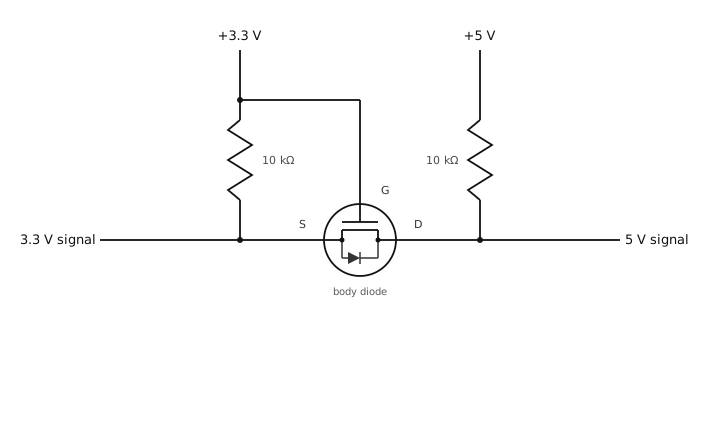
A single N-MOSFET bridges a 3.3 V and a 5 V line; each side has its own pull-up.
The gate is tied to the 3.3 V supply, so the MOSFET’s behaviour depends on which side is driving:
Both sides idle. Source sits at 3.3 V via the left pull-up; gate is at 3.3 V;
Vgs = 0; the MOSFET is off. The 5 V side floats to 5 V via the right pull-up. Both sides read high.3.3 V side pulls low. Source drops to 0 V;
Vgsrises above threshold; the MOSFET turns on and conducts source-to-drain. The 5 V side is pulled low through the transistor.5 V side pulls low. Drain drops to 0 V; the MOSFET’s body diode (drain to source) becomes forward-biased and conducts; the source (3.3 V side) is pulled down to about 0.6 V.
Vgsthen exceeds threshold and the MOSFET fully turns on, bringing both sides low.
The BSS138 is the standard N-MOSFET for this pattern; small-signal logic-level N-MOSFETs with similar gate-threshold voltages all behave the same way here.