
 OpenMV MicroPython
6.27. Watchdog timer
A watchdog timer is a piece of hardware that resets the microcontroller if the running script ever stops periodically poking it. The script “feeds” the watchdog from somewhere it knows is running healthy code; if a bug, a hang, or an unexpected exception ever keeps the camera from feeding the watchdog within a configured timeout, the chip resets itself and the script starts fresh.
On a deployed device with no human nearby to power-cycle it, this is the difference between a transient bug that recovers in seconds and a brick that needs a service call.
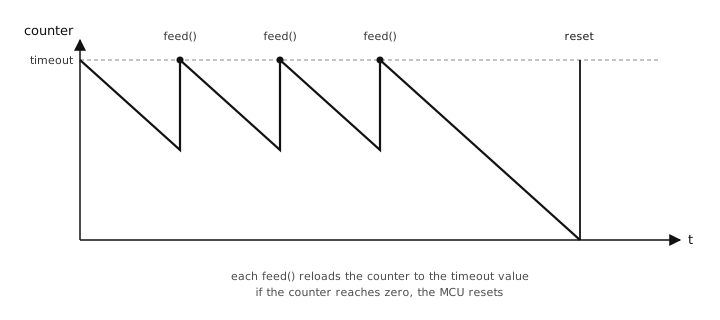
The watchdog counter ticks down from its timeout. Each
feed() reloads it; if it reaches zero, the chip resets.
6.27.1. The machine.WDT class
machine.WDT enables the watchdog and exposes a single
method, feed(). Once started, the watchdog
cannot be stopped – the only ways out are feeding it on
schedule or letting it reset the chip:
from machine import WDT

wdt = WDT(timeout=2000)    # reset if not fed within 2 seconds

while True:
    do_work()
    wdt.feed()
The timeout is in milliseconds. The right value depends on
how long the longest legitimate iteration of the main loop
takes, with comfortable headroom – a 100-ms loop with a 2-s
timeout has plenty of margin for a slow iteration without
nuisance resets.
6.27.2. Where to call feed()
Where feed() lives is the critical design decision; the
watchdog only catches bugs in the parts of the code that do
not run between feeds.
Call from the main loop, at the top or bottom. The most common pattern. The watchdog catches anything that hangs the main loop – a deadlock, an infinite
while, a peripheral that never returns – and resets the chip back into the loop.Do not call from an interrupt handler. The point of the watchdog is to catch hangs in the normal code path. An ISR that fires regardless of whether the main loop is stuck would keep feeding a watchdog that should be triggering.
Do not call from inside a long blocking operation. A network request or sensor read that takes ten seconds is exactly the kind of hang the watchdog should catch. Putting
feed()inside it defeats the protection.
A guideline that works for most programs: feed once per main
loop iteration, with the timeout set to several times the
expected loop duration. If a single iteration legitimately
needs longer than the timeout – a deliberate calibration
phase, say – structure that phase as a series of smaller
chunks with feed() between them, or change the timeout
with timeout_ms() (where supported) before
entering it.
6.27.3. Availability
The watchdog is exposed on most OpenMV cams but not all – the
hardware is present on every part, but the Python API is not
yet wired up everywhere. Check the OpenMV Boards
or attempt to construct a WDT and catch the
AttributeError if it is not supported.
Even on cams where WDT is not exposed, a
field-deployed device can use a soft equivalent – a separate
task or main-loop step that monitors progress and triggers
machine.reset() if anything looks wedged. It is less
robust than a hardware watchdog (a wedged interrupt handler
can take down the soft monitor too) but it covers the same
cases at the application level.