
 OpenMV MicroPython
6.21. SPI basics
SPI (Serial Peripheral Interface) is a synchronous serial bus designed for short-range, high-speed links between one controller and one or more peripheral devices on the same board. It is the standard interface for SD cards, displays, flash memory, ADCs and DACs, and a wide range of sensors.
Where UART had no shared clock and recovered timing from the data line itself, SPI runs a clock wire alongside the data wires. The controller drives the clock at whatever rate it likes, and every other device on the bus samples the data in sync with that clock. There is no baud-rate guessing and no framing overhead – just clock edges and bits.
6.21.1. The four wires
A full-duplex SPI bus has four wires:
SCK (serial clock). Driven by the controller. Every bit is clocked in or out on an edge of this signal.
MOSI (controller out, peripheral in). The controller’s output line; the peripheral samples bits off it.
MISO (controller in, peripheral out). The peripheral’s output line; the controller samples bits off it.
CS (chip select), sometimes called SS (peripheral select). A separate line per peripheral. The controller pulls CS low to start a transaction and high again to end it; any peripheral with its CS deasserted ignores the bus entirely and stops driving its MISO output.
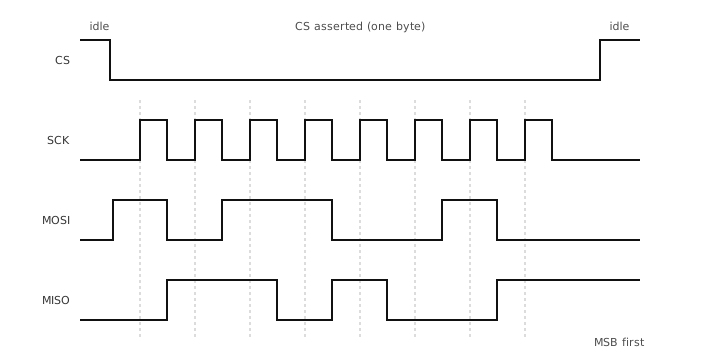
One SPI byte: CS goes low to select the peripheral, SCK clocks eight bits, and MOSI and MISO transfer one byte each in opposite directions.
Every clock edge moves one bit in each direction at the same time. A single SCK pulse simultaneously sends one bit on MOSI and receives one bit on MISO – SPI is full-duplex at the wire level. Software does not have to use both directions: write-only and read-only transactions are common, with the unused line either ignored or kept high.
6.21.2. Clock polarity and phase
Two configuration bits decide exactly which clock edge moves data:
Clock polarity (
polarity, sometimesCPOL) – the idle state of SCK.0means the clock idles low and pulses high;1means the clock idles high and pulses low.Clock phase (
phase, sometimesCPHA) – which edge samples the data.0samples on the first edge of each clock pulse (leading edge);1samples on the second edge (trailing edge).
Together these give four modes, conventionally called Mode
0 through Mode 3. Mode 0 (polarity=0, phase=0) is the most
common and a safe default for unknown devices.
The crucial rule is that both ends must agree on the mode. Mismatched modes give garbage data even though the clock and data lines are wired correctly; if a device returns nonsense on the first transaction, the mode is the first thing to check.
6.21.3. Multiple peripherals
Several peripherals can share the same SCK, MOSI and MISO lines as long as each one has its own CS line driven by the controller:
All peripherals see the same clock and data, but each one watches its own CS. With CS deasserted (high), a peripheral ignores SCK and MOSI entirely and leaves MISO in a high-impedance state so it does not fight other devices for the line.
The controller asserts exactly one CS at a time, runs the transaction, and deasserts CS to release the bus.
A microcontroller with a single hardware SPI block can talk to as many peripherals as it has free GPIO pins to spare for CS lines – there is no addressing on the bus itself.
6.21.4. Strengths and weaknesses
SPI’s strengths and weaknesses both flow from its design:
Fast. Tens of megahertz is achievable on short traces with simple level translation. SD-card readers and SPI displays use this.
Simple at the wire level. No addressing, no acknowledgements, no special start/stop conditions – just bits on the wires synchronised to a clock.
Pin-hungry. Three shared lines plus one CS per peripheral. A board with five SPI devices uses eight pins (three + five).
Short-range. SPI assumes clean, fast edges, which means short traces on the same board. For longer links, I2C or one of the framed buses is a better fit.