
 OpenMV MicroPython
7.11. Frame differencing
Frame differencing compares each new frame against a stored reference frame to find the parts of the scene that have changed. It is the workhorse of camera applications that watch for something happening – motion-triggered capture, intrusion alerts, “save a video when something moves” – and it is built entirely from the pixel-wise operations covered earlier: an absolute difference, a threshold, and a region search, run on every frame.
7.11.1. The basic pipeline
The first stage is to acquire a reference. At some point near startup – ideally when the scene is in the state that “no change” means – the application captures a frame and keeps it. The frame becomes the baseline that every subsequent capture will be compared against.
reference = csi0.snapshot().copy()
The .copy() matters. csi0.snapshot() by
itself returns an Image whose buffer
lives in the frame buffer, where the next
call to snapshot will overwrite it.
.copy() allocates a separate buffer for
the reference and lets the pixels of this
frame survive past the next capture.
The second stage runs on every frame: capture
a fresh image, then compute the absolute
difference between it and the reference. That
is exactly what difference()
does:
current = csi0.snapshot()
current.difference(reference)
After this call, current holds an image
whose non-zero pixels mark every position where
the scene changed since the reference was
taken, with the magnitude of each pixel
proportional to how much it changed at that
position.
The third stage thresholds the difference
image. The raw difference always contains some
noise: small brightness variations from sensor
shot noise, gradient changes from lighting
drift, sub-pixel jitter from slight camera
motion. A threshold pass –
binary() with a threshold
set above that noise floor – keeps only the
changes large enough to count as real motion
and discards the rest, producing a binary
image whose non-zero pixels are the
actually-changed positions.
The fourth stage extracts connected regions
of that binary mask – groups of adjacent
non-zero pixels that form contiguous patches.
find_blobs() does that in
one call, returning a list of motion regions,
each with a bounding box and a pixel count,
that the rest of the application can act on.
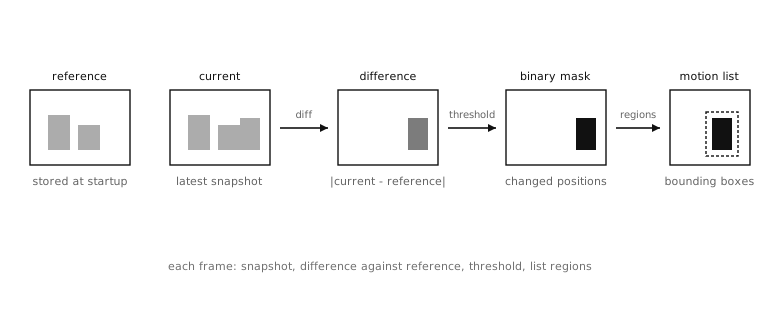
The frame-differencing pipeline: a reference frame plus a current frame become a difference image; thresholding turns the difference into a binary mask of changed positions; a connected-region step turns the mask into a list of motion regions.
7.11.2. In-memory and on-disk references
The basic pipeline keeps the reference frame in RAM. That is the right answer when the reference is captured this run of the script and only has to survive for as long as the script keeps running.
For a long-running application – a cam that should resume change detection after a power cycle, an intermittent script that needs to detect any change since some earlier moment – the reference frame has to outlive the running script. The pattern is to save the reference to disk:
csi0.snapshot().save("/sdcard/reference.bmp")
and to load it back at the start of each run:
reference = image.Image("/sdcard/reference.bmp")
The differencing logic does not change; only where the reference lives between captures does. A few refinements naturally extend this on-disk variant – automatic re-capture of the reference on a timer, optional rolling averages to track slow lighting drift – but the substitution at the centre is the same.
7.11.3. Light-source isolation
The same subtraction pattern shows up in a slightly different setting: isolating a light source against the rest of the scene. The trick is to capture a “lights-off” reference – a frame taken when whatever is being detected (an IR beacon, a screen pixel, a status indicator) is not illuminated – and to subtract that reference from each subsequent frame. The result has zero brightness everywhere the scene was the same in both captures, and non-zero brightness only where the light source actually lit up.
7.11.4. Choosing difference or sub
A practical note about which arithmetic
operation to pick.
difference() returns the
absolute value of the change – sign-free –
which makes it sensitive to change in either
direction (brightening or darkening) at the
cost of not telling the application which
direction the change went. For pure motion
detection that is the right answer: anything
that moved is interesting, regardless of
which way the brightness shifted.
For light-source detection, the lit pixel is
always brighter than the lights-off
reference, so sub() (with
its clipping at zero) is the more honest
choice. Anywhere the current frame is darker
than the reference (which would be sensor
noise around the unlit value)
clips to zero rather than reporting a spurious
“the light was on” signal.